
There is no city-mandated minimum-night stay for properly licensed vacation rentals in Panama City Beach. What actually controls your booking window is the building itself: condo association rules, the property’s Vacation Rental Certificate status, and its posted occupancy limit. Know those three things before you book, and a short getaway from Indiana gets a lot easier to plan.
TL;DR:
- Most buildings set their own minimum-night rules, with shorter stays typically available only in smaller complexes or through direct owner negotiation.
- Confirming the property’s current Vacation Rental Certificate and posted occupancy limit is essential, as violations can lead to last-minute cancellations or shutdowns.
- Short-stay costs often include flat cleaning fees and higher nightly rates, which can make shorter bookings more expensive per night compared to weekly rentals.
- Flexibility increases with midweek or shoulder-season bookings, and direct communication with owners improves chances of securing shorter or last-minute stays.
- Renting legally requires paying a 5% tourist development tax and ensuring the property has the proper licensing, regardless of stay length.
Table of Contents
- Does Panama City Beach Have a Minimum Stay Requirement?
- Why Do Minimum-Night Rules Vary So Much by Building?
- How Do You Find PCB Rentals That Allow Short or Flexible Stays?
- What Fees and Costs Affect a Short PCB Stay?
- Your Pre-Booking Checklist for Short PCB Stays
- Mistakes Indiana Travelers Make Booking Short PCB Stays
- Book Direct and Skip the Guesswork on Minimum Stays
- Sources
- FAQ
Does Panama City Beach Have a Minimum Stay Requirement?
Panama City Beach does not set a citywide minimum-night rule for vacation rentals. Florida’s state preemption law blocks municipalities from banning short-term rentals outright or dictating how many nights a guest must book, so the city’s regulatory energy goes toward safety and registration instead of duration.
That regulation runs through Ordinance 1632, which created the Vacation Rental Certificate (VRC) program. Every legally operating vacation rental in the city needs a valid VRC, and it’s unlawful for an owner to rent or allow occupancy without one, according to the city’s short-term rental page. Getting that certificate requires an annual fire and life-safety inspection, and the inspection result determines the unit’s legal occupancy count.
Occupancy isn’t a guess either. Local rules calculate it using square footage per person, typically 150 square feet per person for one and two-family dwellings and 200 square feet per person for other vacation rentals, based on Florida Administrative Code and NFPA 101 Life Safety standards. A fire inspector can adjust that number based on exits, layout, and safety features.
Statistic Callout: A property without a current VRC isn’t just risking a fine. It’s legally barred from hosting guests at all, regardless of what the listing says.
What this means for your trip:
- No city law forces you into a 3-night or 7-night minimum.
- The VRC and its inspection cycle determine whether a unit can legally host you at all.
- Posted occupancy limits are non-negotiable, even if your group is one person over.
- Noncompliant units risk shutdown mid-season, which can cancel your reservation with little notice.
Why Do Minimum-Night Rules Vary So Much by Building?
If the city doesn’t set minimums, who does? Almost always, it’s the condo association or the property management company running that specific building. Their governing documents, known as CC&Rs, frequently lock in rental policies that override whatever flexibility state law allows.
This is why one Gulf-front tower might rent nightly while the building next door insists on a full week. Market data on PCB rentals shows a consistent pattern across the area:
- Nightly stays: available in a smaller number of buildings, mostly smaller condo complexes and individually owned homes without an association minimum.
- 2 to 3 night minimums: common in mid-size condo buildings that want to discourage one-night turnovers.
- 7-night minimums: typical in larger resort-style towers built around Saturday-to-Saturday turnover schedules, especially during summer.
- Some buildings require monthly minimum stays, generally 30 nights or longer. These favor seasonal or long-term tenants
Associations often set these rules to manage wear on shared elevators, pools, and hallways, or simply because week-long family bookings are easier to staff for. Listing language tends to tip you off before you even ask: a property marketed for “weekly Gulf-front getaways” is signaling a 7-night policy, while one advertised with phrases like “flexible arrival” or “short getaways welcome” usually allows something shorter.
How Do You Find PCB Rentals That Allow Short or Flexible Stays?
Finding a flexible booking window takes a bit more digging than a standard vacation search, but the process is straightforward once you know what to check.
- Filter smart. Use search filters for nightly or short-stay availability rather than browsing broad “beach house” categories, and check the Vacation Rentals listings page for calendar gaps between longer bookings. Gaps of 2 or 3 open nights on a calendar are often a sign the property accepts shorter fill-in stays.
- Contact the owner or manager directly rather than relying only on the calendar. Ask three specific questions: does the building’s association enforce a minimum-night rule, is the property’s VRC current, and what is the posted occupancy limit?
- Ask about exceptions. Some managers will accept a short stay to fill a gap between longer bookings, especially in shoulder months like April or October, even if the standard listing says otherwise.
- Travel midweek or off-peak. Tuesday-to-Friday stays and shoulder-season dates open up availability that weekends and summer holidays never will.
- Request documentation before you pay. Ask for the VRC number, the posted occupancy figure, and a written fee breakdown.
Pro Tip: Book your call with the property manager for early morning or midweek. Managers juggling weekend turnovers are far more likely to negotiate a short stay when their week isn’t already packed.
What Fees and Costs Affect a Short PCB Stay?
Shorter stays come with the same fixed costs as longer ones, which changes the math in ways worth knowing before you commit. Owners operating legally must register for a city business tax receipt, collect Bay County’s 5% tourist development tax, and hold a DBPR vacation rental license. None of that changes based on how many nights you stay, but it does show up in your total.
Statistic Callout: Bay County applies a 5% tourist development tax in addition to Florida’s state sales tax, which applies regardless of the number of nights booked.
Here’s where short stays get pricier per night:
- Cleaning fees are typically flat, so a 2-night stay absorbs the same cleaning charge as a 7-night stay, making the per-night cost far higher.
- Nightly rates for short bookings often run higher than the blended rate on a week-long reservation.
- Cancellation policies tend to be stricter on short stays, since owners have less flexibility to rebook a lost weekend than a lost week.
A few habits can offset this. Booking midweek dates almost always saves money, some managers will negotiate a lower cleaning fee for a last-minute short-stay booking that fills a gap, and booking early for peak summer weekends beats scrambling for a same-week opening.
Your Pre-Booking Checklist for Short PCB Stays
Before you send payment for any short-stay booking, run through this list with the owner or manager.
- Ask for the VRC number and confirm the unit passed its most recent annual fire inspection.
- Ask directly: does the building or association enforce a minimum-night rule, and are exceptions ever granted?
- Request a full fee schedule, including cleaning fee, service fee, city business tax, and county bed tax.
- Get the cancellation and refund policy in writing, not just a verbal assurance.
- Confirm the posted occupancy limit, parking rules, and any age or pet restrictions that could affect your group.
Save the answers in a text message or email. If anything changes before your arrival date, you’ll have a record to point back to.
Mistakes Indiana Travelers Make Booking Short PCB Stays
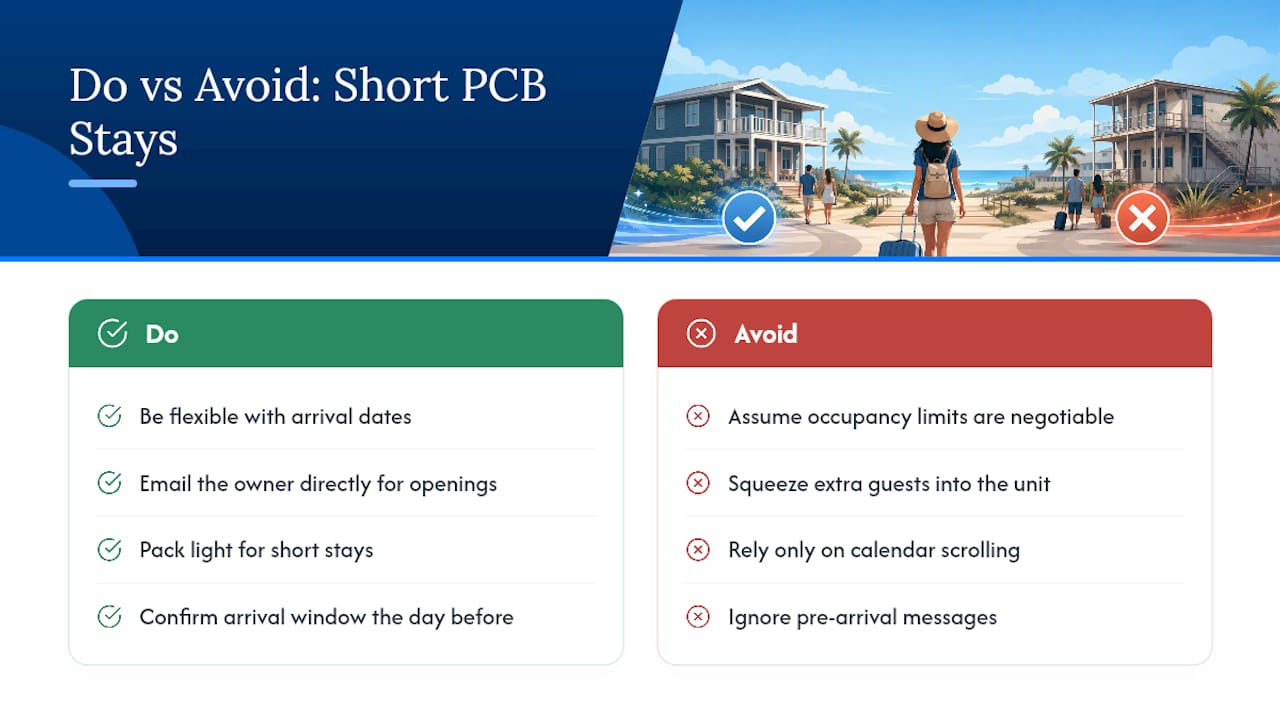
The most common mistake isn’t a missed minimum-night rule. It’s assuming a listing’s advertised occupancy is negotiable when it’s tied to a fire inspection. Squeeze one extra person into a unit rated for six, and you’re not just uncomfortable. You’re violating a legal occupancy limit the property can’t waive.
Flexible dates beat rigid ones almost every time. Groups willing to shift a Friday arrival to a Wednesday, or willing to email an owner directly instead of only scrolling calendars, land better short-stay openings. Pack light, plan for self check-in where the listing allows it, and confirm your arrival window the day before. A few extra minutes of message-checking saves an entire evening of confusion at the door.
— Joe
Book Direct and Skip the Guesswork on Minimum Stays
Panamacitybeachflorida.com puts you in direct contact with the people who actually set the minimum-night policy, the owners and managers themselves, which means you get a straight answer instead of a rigid online calendar. Browse beachfront condos, family-friendly homes, and pet-friendly rentals, then message the listing contact directly to confirm VRC status and any building minimum before you commit.
Booking direct can sometimes provide more flexibility to ask about short stays, midweek gaps, or last-minute openings than big third-party platforms. Start your search on the Vacation Rentals page, filter for your dates, and reach out to a few owners with the checklist questions above. If you want a starting point with strong Gulf views and family-friendly space, this property is worth a look. Confirm the VRC number and fee breakdown on the listing page before you pay, and you’ll walk into your Panama City Beach trip with zero surprises waiting at check-in.
Sources
- Ordinance 1632 (PDF) — Panama City Beach
- Panama City Beach Short-Term Rental Rules (2026) — STR Law Map
- Panama City Beach Short Term Rental Regulations (2026 Guide) — The Short Term Shop
Recommended
- What PCB Rental Cancellation Policies Mean for Your Refund
- Airports Near PCB: Your Panama City Beach Travel Guide
- Best Condo Rental Companies in Panama City Beach
- How to Choose a Vacation Rental That Actually Fits Your Trip

About the Author
Joe Godar of the PanamaCityBeachFlorida.com Editorial Team creates destination guides, vacation-planning resources, and local travel content focused on Panama City Beach, Florida.
Our team researches local beaches, vacation rental trends, family activities, restaurants, attractions, events, and direct-booking best practices. Every guide is created to help travelers plan more confidently, experience the best of Panama City Beach, and avoid unnecessary third-party guest service fees.
PanamaCityBeachFlorida.com is part of the Emerald Coast by Owner marketing family, connecting travelers directly with verified vacation rental hosts throughout the Gulf Coast since 2016.
This article was reviewed for accuracy and updated using local destination research and current Panama City Beach vacation rental market insights.