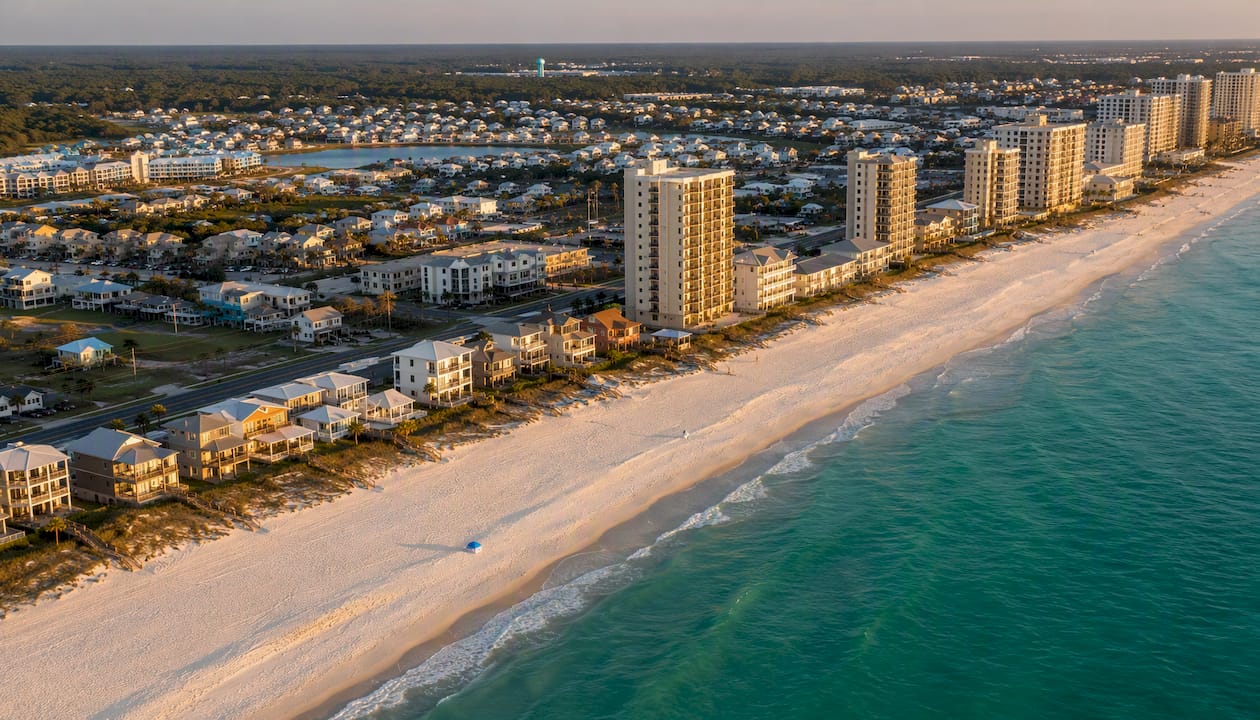
For walkable living with high short-term rental income, Pier Park wins. For quiet beach cottages, look at Laguna Beach, Carillon Beach, or the wider West End. For boating and marina access, Grand Lagoon and Bay Point deliver. Families who want full-time neighborhoods near the action should look at Palmetto Trace and Breakfast Point, while buyers chasing new construction and long-term appreciation should watch Ward Creek and the Highway 79 corridor.
TL;DR:
- Neighborhoods near Pier Park offer the highest weekly rental income due to walkability, but they also experience peak crowds and higher HOA fees during summer months.
- The West End, including Laguna Beach and Carillon Beach, provides quieter, low-rise living options with fewer restrictions, appealing to full-time residents and those seeking a beach cottage atmosphere.
- Marina and boat access are concentrated in Grand Lagoon and Bay Point, ideal for boat owners, but these areas are farther from the main beach strip and come with higher insurance and maintenance costs.
- Inland communities like Palmetto Trace and Breakfast Point are designed for full-time living, with restrictions on short-term rentals and lower insurance costs but no immediate beach access.
- Buyers should thoroughly research HOA rules, flood zones, and insurance costs before committing, and consider apartment stays to experience neighborhoods firsthand.
Table of Contents
- Why Panama City Beach Attracts Buyers and Investors
- Which Panama City Beach Neighborhoods Should You Shortlist?
- What Are Panama City Beach’s Best Neighborhoods Really Like?
- What Growth Corridors Deserve a Look Before You Buy?
- How Do You Choose the Right Neighborhood for Your Goals?
- What Do Prices, Insurance, and Rental Seasons Look Like?
- How Can You Research Panama City Beach Neighborhoods Before You Commit?
- What Should You Watch for on a Neighborhood Visit?
- Try Living There First Before You Buy
- Where Can You Learn More About Panama City Beach Neighborhoods?
- Sources
- FAQ
Why Panama City Beach Attracts Buyers and Investors
Panama City Beach runs along a substantial length of Gulf coastline, and that stretch is long enough to hold a dozen distinct micro-markets inside one beach town. That’s the first thing Missouri buyers underestimate when they start browsing listings online: this isn’t one neighborhood with different price tags, it’s a string of communities with their own character, zoning, and rental economics.
The market pulls buyers for a few concrete reasons. Pier Park anchors the central corridor with shopping, dining, and entertainment that keeps foot traffic and rental bookings high year-round. St. Andrews State Park and the short ferry ride to Shell Island give the west side its own draw for boaters and snorkelers. And Northwest Florida Beaches International Airport sits close enough to the coast that Missouri families flying down for a long weekend aren’t burning half a vacation day on a rental car.
Panama City Beach also functions as one of the more accessible entry points into Gulf Coast real estate. Compared with pricier corridors like 30A, PCB delivers stronger weekly-rental demand at a lower buy-in, which is exactly why investors from landlocked states keep circling back to it.
A few market realities worth knowing before you start comparing neighborhoods:
- Inventory ranges broadly from more affordable studio condos to expensive gulf-front penthouses.
- Rental demand stays strong from spring through early fall, with a secondary bump around the holidays.
- Property types vary sharply by micro-market: including high-rise towers near Pier Park, low-rise cottages on the West End, and dockside single-family homes around Grand Lagoon.
- Distance from the beach itself changes both price and insurance cost more than almost any other factor.
Pro Tip: Don’t shop by price per square foot alone. A condo three blocks from the sand in a walkable pocket often out-earns a slightly cheaper unit that’s oceanfront but isolated from restaurants and shops.
Which Panama City Beach Neighborhoods Should You Shortlist?
Once you understand the market’s shape, narrowing down Panama City Beach neighborhoods gets a lot easier. Here’s a working shortlist built around lifestyle and investment goals rather than alphabetical order.
- Pier Park corridor. The busiest, most walkable stretch of the beach, built for buyers who want retail, dining, and entertainment within a short walk and consistent short-term rental bookings.
- West End: Laguna Beach and Carillon Beach. Low-rise buildings, fewer crowds, and a slower pace that suits full-time residents and buyers who want a beach cottage feel over a high-rise skyline.
- Grand Lagoon and Bay Point. The go-to pick for boat owners, with marina access, dockable lots, and a maritime community vibe that’s distinct from the beachfront strip.
- Palmetto Trace and Breakfast Point. Inland, gated, family-oriented communities that put full-time residents close to Pier Park’s jobs and schools without the beachfront price tag.
- Ward Creek, the Highway 79 corridor, and Latitude Margaritaville. The newest construction on the map, attractive to buyers betting on appreciation as infrastructure and retail catch up to the housing.
Each of these areas solves a different problem. Pier Park solves the “I want bookings every week” problem. Laguna Beach and Carillon solve the “I don’t want to hear a hotel pool speaker at 11 p.m.” problem. Grand Lagoon and Bay Point solve the “my boat needs a home too” problem. Palmetto Trace and Breakfast Point solve the “I actually live here year-round” problem. And the Highway 79 corridor solves the “I want to buy before prices catch up” problem.
Local real estate guides consistently name Bay Point, Wild Heron, Carillon Beach, the West End, and the Highway 79 corridor among the top picks in Panama City Beach, and that consensus lines up closely with how the shortlist above breaks down by lifestyle. Wild Heron deserves a special mention here: it sits north of the main tourist strip along Lake Powell, and it’s built almost entirely around privacy and natural surroundings rather than beach access, which makes it a different animal from anything else on this list.
What Are Panama City Beach’s Best Neighborhoods Really Like?
Numbers and rankings only tell you so much. Here’s what living or investing in each of these Panama City Beach neighborhoods actually feels like day to day.
The Pier Park core
Pier Park itself isn’t a residential subdivision. It’s the commercial and cultural center that the surrounding condo towers and mid-rise buildings orbit. Buyers here are typically choosing a high-rise unit within walking distance of movie theaters, restaurants, and beach access points that see heavy foot traffic all season.
Property types skew toward condo towers, ranging from older buildings with entry-level condos to newer gulf-front towers with higher-priced two-bedroom units. Full-building amenities like pools, elevators, and covered parking are standard, but so are condo association fees that can run several hundred dollars a month.
This is the strongest zone in Panama City Beach for weekly-rental demand, largely because guests want to walk to dinner without moving their car. It’s also the most tourist-heavy stretch, so full-time residents trade quiet for convenience.
Pros:
- Highest short-term rental occupancy and nightly rate potential on the beach
- Walkable to shopping, dining, and entertainment without a car
- Strong resale liquidity because demand from investors stays consistent
Cons:
- Traffic and crowds peak hard from May through August
- HOA fees and building rules can restrict how, and how often, you rent
- Limited single-family inventory; almost everything here is a condo
West End: Laguna Beach and Carillon Beach
Head west past the main tourist strip and the character shifts fast. Laguna Beach and Carillon Beach are lower-density pockets built around low-rise buildings, townhomes, and a handful of single-family homes rather than towers. Local buyer guides group these West End pockets together as the quieter alternative to the Pier Park corridor, and that reputation holds up on the ground.
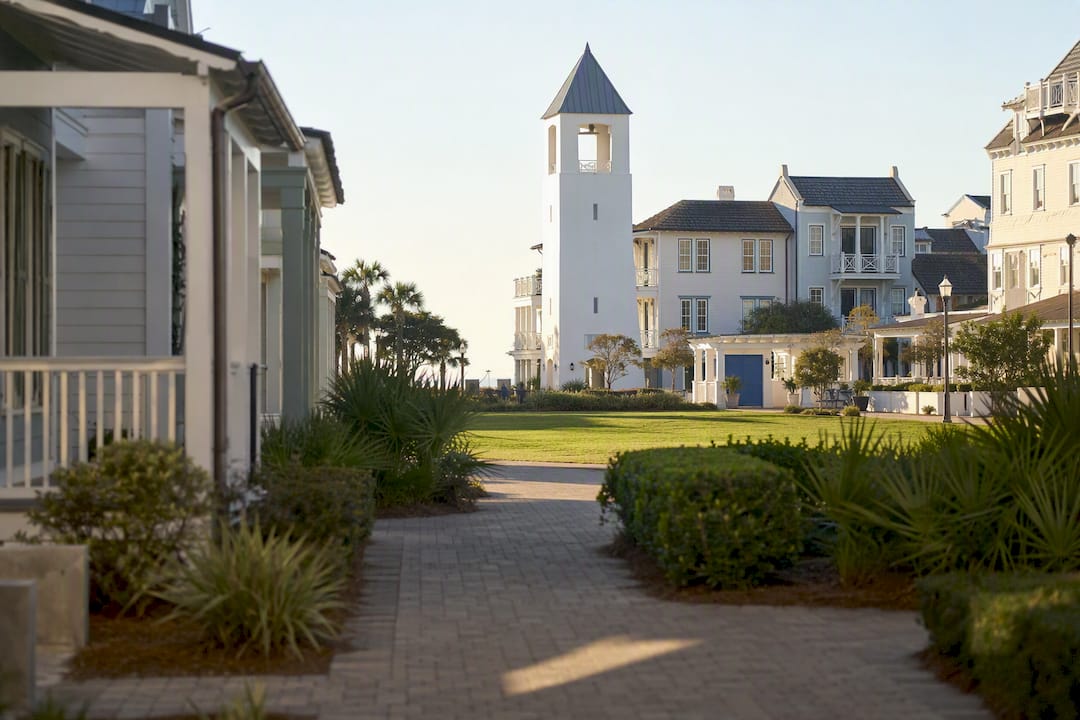
Carillon Beach in particular has a walkable, small-town design with a central green space, a bell tower, and beach cottages that feel more like a coastal Missouri lake community than a typical condo strip. Prices for cottages and townhomes here commonly cover a broad range, reaching higher values for larger gulf-front homes.
Laguna Beach, meanwhile, tends to have fewer restrictive HOA structures than newer gated developments, which can be a real advantage for owners who want flexibility on short-term rental scheduling rather than fighting a board over calendar rules.
Pros:
- Quieter, lower-density feel without giving up beach proximity
- Fewer high-rise towers means better long-term views and less shadowing
- Strong appeal to buyers who want a full-time home, not just an investment unit
Cons:
- Fewer walkable retail and dining options than Pier Park
- Some pockets have limited public beach access points
- Inventory turns over less often, so patience matters when shopping
Pro Tip: Before you make an offer in Laguna Beach or Carillon, ask specifically whether the parcel sits inside Panama City Beach’s city limits or in unincorporated Bay County. That single line item changes your short-term rental rules and local business tax obligations.
Grand Lagoon and Bay Point
If your household includes a boat, this is where you look first. Grand Lagoon sits at the western edge near the Thomas Drive corridor and St. Andrews State Park, an area that functions as a hub for boating-oriented visitors and vacation rentals alike. Bay Point pushes that further with a private, gated marina community that includes a golf course and resort amenities alongside dockable single-family homes.
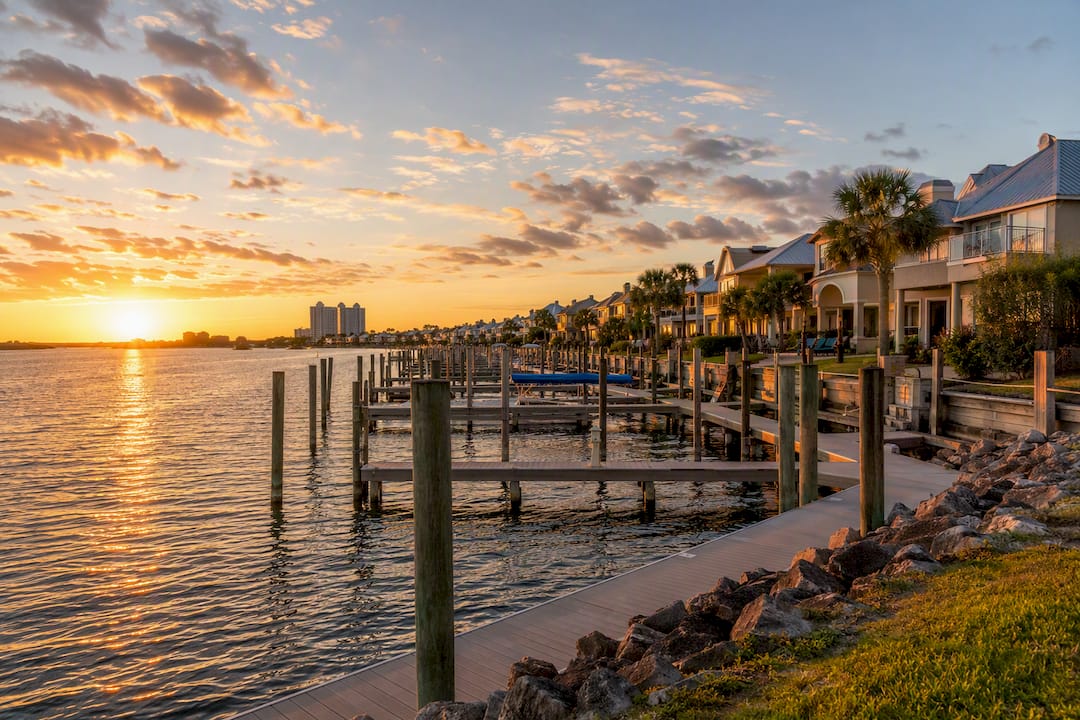
Property types here split between waterfront single-family homes with private docks and condo units overlooking the marina. Entry-level condos start at moderate prices, while dockable single-family homes with deep water access generally command higher prices.
Bay Point specifically draws buyers who want a private, guard-gated community with golf and marina access bundled together, a different product entirely from the beachfront condo experience.
Pros:
- Direct boat access and marina slips in many properties
- Gated privacy in Bay Point, away from tourist congestion
- Golf course and resort-style amenities add year-round appeal beyond summer
Cons:
- Farther from the main beach strip, so walkability drops
- Dock and seawall maintenance adds ongoing cost most buyers don’t budget for
- Insurance for waterfront property here often costs more than beachfront condos due to flood zone mapping
Inland residential enclaves: Palmetto Trace and Breakfast Point
Not every Panama City Beach buyer wants a rental property. Palmetto Trace and Breakfast Point are gated, inland communities built for people who actually live here, close enough to Pier Park for a five-minute commute but insulated from tourist traffic.
Housing stock is almost entirely single-family, including starter homes and larger family houses in the mid-price range. These communities typically carry HOA rules that restrict or ban short-term rentals altogether, which is exactly the point for buyers prioritizing a stable, family-friendly street over rental income.
Pros:
- Full-time, family-oriented feel with sidewalks, pools, and community parks
- Close enough to Pier Park for shopping and dining without beach traffic
- Generally lower insurance costs than beachfront property, since these sit north of Highway 98
Cons:
- Not built for short-term rental income; most HOAs restrict it
- No direct beach access; a car ride is required for sand and surf
- Less resale demand from out-of-state investors than beachfront zones
What Growth Corridors Deserve a Look Before You Buy?
Ward Creek and the Highway 79 corridor represent the next wave of Panama City Beach development, and they’re worth watching whether you’re buying to live or buying to hold. This stretch runs north from the beach along Highway 79, connecting older residential pockets to newer subdivisions and commercial development that’s still filling in.
The appeal is straightforward: land here was cheaper to develop than anything near the water, so builders can offer more square footage per dollar, and buyers get in before amenities like grocery stores and restaurants fully catch up to the rooftops. That gap between built homes and finished infrastructure is exactly where early buyers find upside, and exactly where risk lives too.
Latitude Margaritaville sits within this broader growth zone and represents a different product entirely: an age-qualified, 55-plus master-planned community with amenity-rich clubhouses, pools, and organized activities. It’s not competing with beachfront condos for renters. It’s competing with other active-adult communities for full-time residents who want resort amenities without beach maintenance.
Before buying in a growth corridor, weigh a few practical points:
- Builder-direct pricing on new construction often carries a premium over comparable resale homes once a phase sells out.
- Infrastructure like retail, schools, and road capacity can lag housing completion by a year or more.
- Resale value in unfinished developments depends heavily on whether the builder completes later phases on schedule.
- HOA fees in amenity-heavy communities like Latitude Margaritaville tend to run higher than in older, simpler subdivisions.
How Do You Choose the Right Neighborhood for Your Goals?
Matching yourself to the right Panama City Beach neighborhood comes down to running through the same checklist every serious buyer should use, in order.
- Set your budget ceiling first, including estimated insurance and HOA costs, not just the sale price.
- Define your use case. Full-time residence, seasonal second home, or pure rental investment each points to a different neighborhood.
- Check HOA and short-term rental rules before you fall in love with a property, since restrictions vary widely between city limits and unincorporated Bay County.
- Pull the flood zone and insurance quote early, ideally before you write an offer, not after.
- Map the commute and school zone if you’re relocating full-time, especially for Palmetto Trace, Breakfast Point, or inland Highway 79 properties.
Ask your agent for the HOA’s governing documents, the last two years of association meeting minutes, and any pending special assessments before closing. Sample questions worth asking directly: “Is there a minimum rental period?” and “Has flood insurance premium changed in the last three years?”
A few red flags should slow you down. An HOA that can’t produce recent financials, a seller who’s vague about whether short-term rentals are currently permitted, or a flood insurance quote that’s dramatically higher than similar listings nearby all deserve a second look before you proceed.
Pro Tip: Get the flood zone designation in writing from the insurance agent, not just the listing sheet. Zone maps get updated, and a property advertised as “X zone” a year ago may have been remapped since.
What Do Prices, Insurance, and Rental Seasons Look Like?
Price and risk in Panama City Beach neighborhoods track almost entirely with one line: Highway 98. Properties south of it, closer to the Gulf, generally carry higher flood insurance premiums and stricter building codes because they sit in higher-risk flood zones. Properties north of Highway 98, including Palmetto Trace, Breakfast Point, and much of the Highway 79 corridor, typically see meaningfully lower insurance costs even when square footage and finishes are comparable.
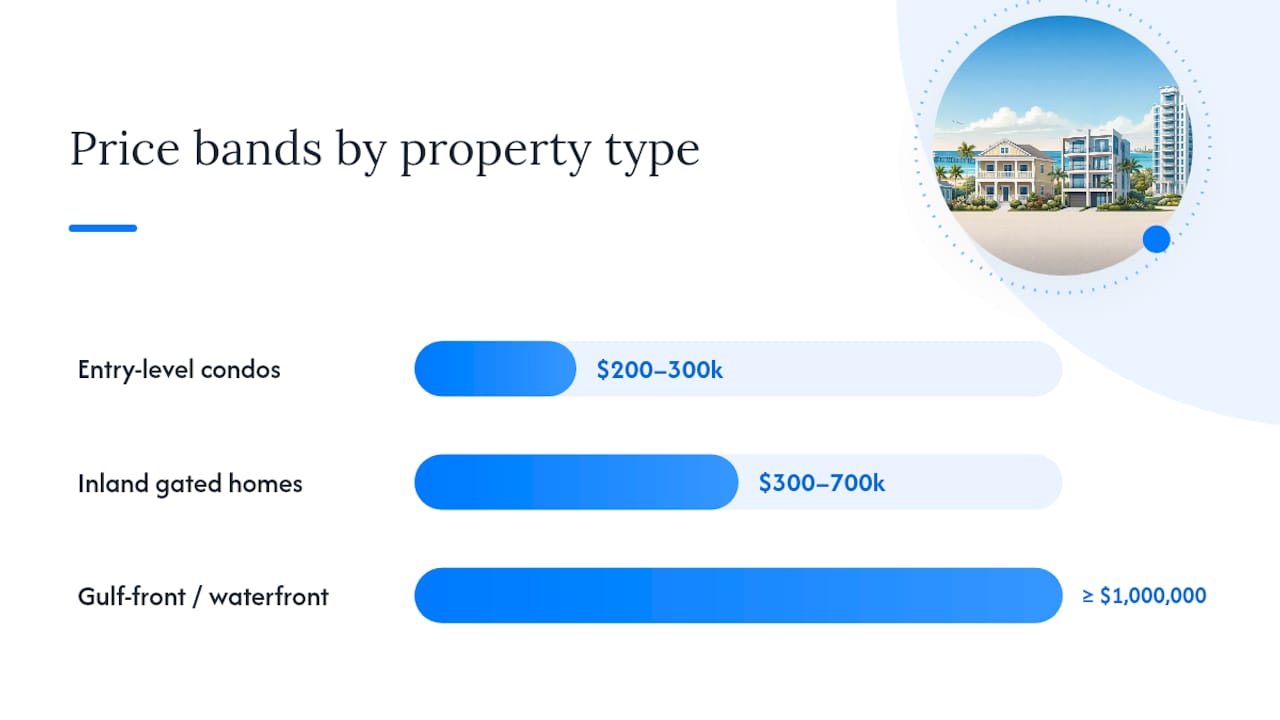
Rough price bands across the market: entry-level condos start around $200,000 to $300,000, single-family homes in inland gated communities run $300,000 to $700,000, and gulf-front towers or dockable waterfront homes frequently clear $1 million.
Insurance for coastal Florida property typically layers three separate policies: standard homeowners, wind/hurricane coverage, and flood insurance, and all three price out differently depending on your elevation certificate and flood zone map designation. Buyers coming from Missouri, where flood insurance is rarely mandatory, are often caught off guard by how much this adds to monthly carrying costs on a beachfront unit.
Rental seasonality matters just as much for investment math. Occupancy and nightly rates peak from Memorial Day through Labor Day, dip through fall, then bump again around the holidays before a slower stretch in January and February. Any revenue projection that assumes summer rates hold year-round will overstate returns.
- Expect insurance costs to run notably higher south of Highway 98 than for comparable inland properties.
- Hurricane season runs June through November, and closing timelines can slip when storms threaten the coast.
- Weekly rental demand stays strongest in the neighborhoods closest to Pier Park and the main beach access points.
How Can You Research Panama City Beach Neighborhoods Before You Commit?
Panama City Beach’s own vacation rental market is one of the most useful research tools available to a buyer, and it’s worth using before you sign anything. Rental listings are available across the full 27-mile coastline, covering beachfront condos, beach homes, and pet-friendly properties in many neighborhoods.
Browsing neighborhood-specific rental guides gives you a preview of what a specific building or block actually feels like, from noise level to walkability, without committing to a mortgage first. Pairing that with a look at what renters expect from private-pool properties also tells you a lot about buyer amenity expectations in that price tier.
What Should You Watch for on a Neighborhood Visit?
Visit twice: once on a Saturday afternoon in season, once on a weekday morning off season. The gap tells you everything about traffic, noise, and parking pressure. Walk the actual block, not just the property, and time how long it genuinely takes to reach the sand.
Pier Park feels electric on a Friday night and dead quiet on a Tuesday in February, which is exactly the trade-off you’re buying into. Laguna Beach barely changes between those two visits, and that consistency is the whole appeal for buyers who want a full-time home over a rental machine.
— Joe
Try Living There First Before You Buy
Before you commit six figures to a Panama City Beach purchase, spend a week actually staying in the neighborhood you’re circling. That’s the real advantage Some marketplaces offer buyers and investors a way to test a specific block, building, or beach access point at full price transparency, with no obligation beyond the booking itself.
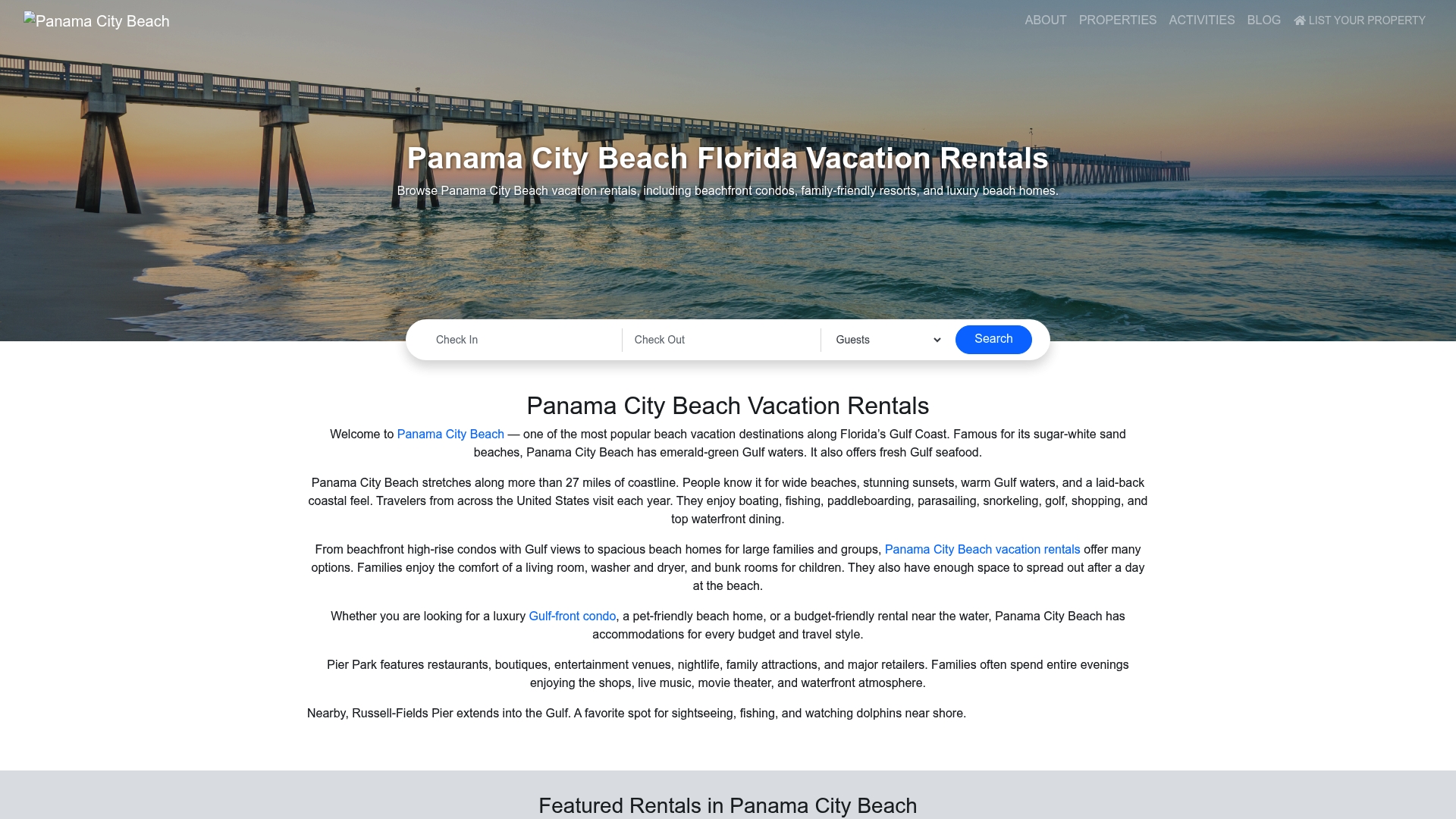
A short stay tells you things a listing photo never will. Does the pool at your target condo get too crowded by 10 a.m. in July? Is the walk to Pier Park’s restaurants really five minutes, or closer to fifteen? Booking through the vacation rentals marketplace lets you preview neighborhoods like Laguna Beach, Grand Lagoon, or the Pier Park corridor from inside an actual unit, often one owned by someone renting the same type of property you’d be buying. If you’re weighing PCB against other Gulf Coast options, it also helps to see how the destination compares to Gulf Shores before narrowing your search further. Start by browsing available stays in your target neighborhood and book a trip before you book a mortgage.
Where Can You Learn More About Panama City Beach Neighborhoods?
- Venture South Real Estate’s PCB guide covers coastline geography and rental market fundamentals in depth.
- Century 21 Ryan Realty’s community breakdown offers a broader look at how micro-markets divide across the beach.
- Panamacitybeachflorida’s Activities page rounds out the lifestyle picture with things to do near each neighborhood.
Sources
- Panama City Beach, FL: The Complete Vacation & Lifestyle Guide - Venture South Real Estate
- Best Communities in Panama City Beach | Ryan Realty
- Best Areas to Live Full-Time in Panama City Beach, FL
- Best Neighborhoods in Panama City Beach (2026 Guide) - GulfLifeGo
Recommended
- Panama City Beach vs Gulf Shores: Which Is Right for You?
- Best Condos in Panama City Beach, FL: 2026 Guide
- Best 1 Bedroom Condos in Panama City Beach, FL 2026
- Vacation Rentals with Private Pool in Panama City Beach

About the Author
Joe Godar of the PanamaCityBeachFlorida.com Editorial Team creates destination guides, vacation-planning resources, and local travel content focused on Panama City Beach, Florida.
Our team researches local beaches, vacation rental trends, family activities, restaurants, attractions, events, and direct-booking best practices. Every guide is created to help travelers plan more confidently, experience the best of Panama City Beach, and avoid unnecessary third-party guest service fees.
PanamaCityBeachFlorida.com is part of the Emerald Coast by Owner marketing family, connecting travelers directly with verified vacation rental hosts throughout the Gulf Coast since 2016.
This article was reviewed for accuracy and updated using local destination research and current Panama City Beach vacation rental market insights.