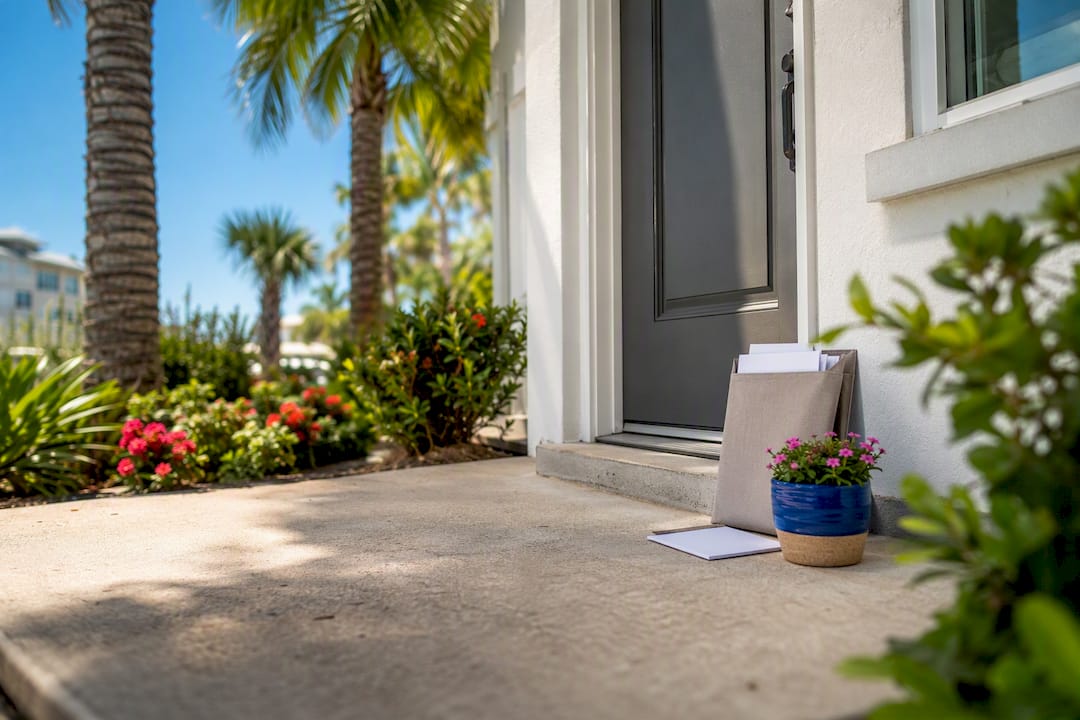
Under Panama City Beach Ordinance 1632, every unit used as a short-term vacation rental must hold a valid Vacation Rental Certificate. Don’t advertise or accept a booking until you have it in hand. Getting there means pulling together your Florida DBPR license, your Tourist Development Tax registration, and a Panama City Beach Business Tax Receipt, then filing through the PCB STR portal.
Start with this sequence:
-
Secure your DBPR transient rental license
-
Register for Tourist Development Tax through Bay Tourist Tax
-
Obtain your PCB Business Tax Receipt
-
Submit your application on the STR portal
-
Schedule your life-safety inspection
Pro Tip: Renting without a certificate isn’t a gray area. The city treats unregistered units as active code violations, and fines accrue from the first night booked, not the date you’re caught.
Key Takeaways
Ordinance 1632 requires a per-unit Vacation Rental Certificate, state and local registrations, a passed life-safety inspection, and correct postings before any short-term rental can legally operate in Panama City Beach.
| Point | Details |
|---|---|
| Certificate is mandatory per unit | Each dwelling needs its own Vacation Rental Certificate under Ordinance 1632, not one blanket approval per building. |
| Stack your registrations first | DBPR license, TDT registration, and PCB Business Tax Receipt must all be active before you apply through the STR portal. |
| Inspections follow fire code | Detectors, extinguishers, egress, and balconies are checked against NFPA 101 and Chapter 509 standards. |
| Zoning and HOA rules can override eligibility | A certified unit can still be barred from renting by its zoning designation or condo covenant. |
| List once you’re compliant | Panamacitybeachflorida’s marketplace gives certified owners a dedicated page to reach travelers already searching for a Panama City Beach stay. |
Table of Contents
PCB Rental Compliance Rules Under Ordinance 1632
Ordinance 1632 lives in Chapter 8, Article IX of the city code, and it defines a “vacation rental” as a transient public lodging establishment rented for periods of less than 30 days or one calendar month, whichever is less, more than three times per year. If your unit fits that pattern, the ordinance applies, regardless of whether you call it a vacation rental, a short-term let, or a weekly rental on your listing.
Each dwelling unit needs its own certificate. A duplex owner registering one side doesn’t cover the other, and a condo building with ten rental units needs ten separate certificates, not one blanket approval for the property.
The ordinance doesn’t operate in isolation. It enforces standards already set by:
-
NFPA 101 (the Life Safety Code) for egress, alarms, and fire protection
-
Florida Statute Chapter 509, which governs public lodging establishments statewide
-
State Fire Marshal rules covering extinguishers, detectors, and emergency signage
Certificates typically run on an annual renewal cycle, which means compliance isn’t a one-time task. It’s a yearly obligation tied to your unit’s continued eligibility to operate. Miss a renewal window and you’re back to square one: no certificate, no legal rental activity.
How to Register and Renew Your Rental Certificate
Getting registered means assembling a specific paper trail before you touch the STR portal. Here’s the order that saves you the most back and forth with city staff:
-
Gather your documents first. You’ll need a notarized affidavit confirming compliance with occupancy and use restrictions, your DBPR license number, proof of TDT registration, your PCB Business Tax Receipt number, and any specialty certificates your unit type requires (pool permits, elevator inspections, and so on).
-
Create your portal account. The city’s Short-Term Rentals page links directly to the application system where you’ll upload documents and pay fees.
-
Pay the correct fee. New registrations and renewals carry different costs, and the city page lists the current schedule, along with separate reinspection and no-show fees.
-
Schedule your inspection. The portal handles scheduling once your paperwork clears initial review.
If you’re buying a property that already operates as a rental, the certificate doesn’t transfer automatically with the deed. New ownership triggers a fresh application, and the previous owner’s certificate becomes void at closing.
Pro Tip: The most common documentation mistake isn’t a missing form. It’s a mismatch. Your DBPR license name, your TDT account name, and your BTR name all need to match the actual property owner or managing entity exactly, or the portal will flag your submission for manual review and add weeks to your timeline.
What Life-Safety Inspections Check and How to Pass
Inspectors work from a checklist grounded in the city’s Vacation Rental Guidelines for Compliance, and most failures cluster around a handful of predictable items:
-
Working smoke and carbon monoxide detectors in every required location
-
Fire extinguishers, charged and accessible
-
Clear egress paths, unobstructed exits, and functional door hardware
-
Balcony structural checks for condo and multi-story units
-
Pool and spa safety compliance where a shared amenity exists
Inspectors typically need someone to grant access. Absentee owners who can’t provide an escort, and don’t arrange for a manager or agent to stand in, risk a lock-out fee for the missed appointment. Reinspections after a failed visit usually carry their own separate fee and a waiting period before the next slot opens.
Owners who pass on the first try tend to do the same three things: they keep dated maintenance logs, they fix known issues before the inspector arrives instead of hoping nobody notices, and they leave a folder of documentation, extinguisher tags, detector test dates, on-site for reference.
Required Signage, Postings, and Occupancy Limits
Every certified unit needs an exterior sign or decal displaying the unit’s certificate or BTR number and a working contact number for the Rental Responsible Party, the person guests can reach if something goes wrong at 2 a.m.
Inside, guests need to see:
-
An evacuation map posted near the main entrance
-
The maximum approved occupancy count
-
Beach flag safety information explaining what each color means
-
Emergency contact numbers, including the Rental Responsible Party
Occupancy limits come from bedroom count and square footage under the ordinance’s formula, and inspectors have authority to revise the approved number if a unit’s layout doesn’t match what’s on file. Posting the wrong number, even by accident, is its own violation.
Fines, Revocations, and What Happens After a Violation
The city uses a progressive enforcement model rather than jumping straight to the harshest penalty. A first violation typically brings a Notice of Violation with a defined window to correct the issue, and repeat or unresolved violations escalate toward fines and, eventually, certificate revocation.
Once a certificate is revoked, the unit can’t legally operate as a short-term rental until the owner reapplies and clears the same inspection and documentation process again, often with added scrutiny.
Enforcement doesn’t stop at the city level. Persistent noncompliance can trigger referrals to the Florida DBPR, the Department of Revenue for unpaid taxes, or a code enforcement magistrate for formal hearings. Correcting a violation fast, inside the cure window, is almost always cheaper and faster than letting it escalate to that level.
Your Owner Compliance Checklist Before Listing
Run through this sequence before your first booking goes live:
-
Confirm your DBPR license, TDT registration, and BTR number are all active and match your ownership records exactly.
-
Complete the notarized affidavit and gather specialty certificates for your unit type.
-
Test every smoke and CO detector, and log the date.
-
Check extinguisher charge and expiration tags.
-
Post exterior signage with your certificate number and contact line.
-
Place interior postings (evacuation map, occupancy limit, beach flag guide) somewhere guests will actually see them, the back of the entry door or the refrigerator work well.
-
Confirm your Rental Responsible Party can respond and provide inspection access.
-
Schedule your inspection through the STR portal with buffer time before your first reservation.
Pro Tip: Keep a simple dated log of detector tests and any corrective repairs. Inspectors ask for this more often than owners expect, and having it ready turns a potential delay into a two-minute conversation.
The single most avoidable mistake: advertising a listing before the certificate is issued. Portal timestamps and booking platform data make it easy for the city to spot a listing that predates approval, and that’s an easy violation to write up.
What “PCB” Means in the Context of Rental Rules
“PCB” is shorthand for Panama City Beach, the municipality along Florida’s Gulf Coast, distinct from Panama City proper and from unincorporated Bay County. That distinction matters more than it sounds, because rental rules don’t apply uniformly across the broader region.
A property inside PCB’s city limits falls under Ordinance 1632 and the city’s own registration, inspection, and enforcement system. A property just outside those limits, in unincorporated Bay County, falls instead under Bay County’s inspection ordinance, which shares the same general spirit (registration, inspection, occupancy rules) but runs through a separate county process with its own forms and fee schedule.
Owners sometimes assume “PCB rental regulations” cover the whole coastal stretch uniformly. They don’t. If you’re not certain which jurisdiction your parcel sits in, check your property address against the city’s boundary maps or call the city’s code enforcement line before you assume Ordinance 1632 applies. A property just across a jurisdictional line might need Bay County’s registration instead, and the paperwork, though similar in structure, isn’t interchangeable.
This is also why “are PCB rentals regulated?” doesn’t have a single flat answer. Every unit inside city limits used as a transient rental is regulated under Ordinance 1632. The specifics of which forms and fees apply depend on exactly where the property sits.
Zoning Rules and HOA Covenants That Can Limit Rentals
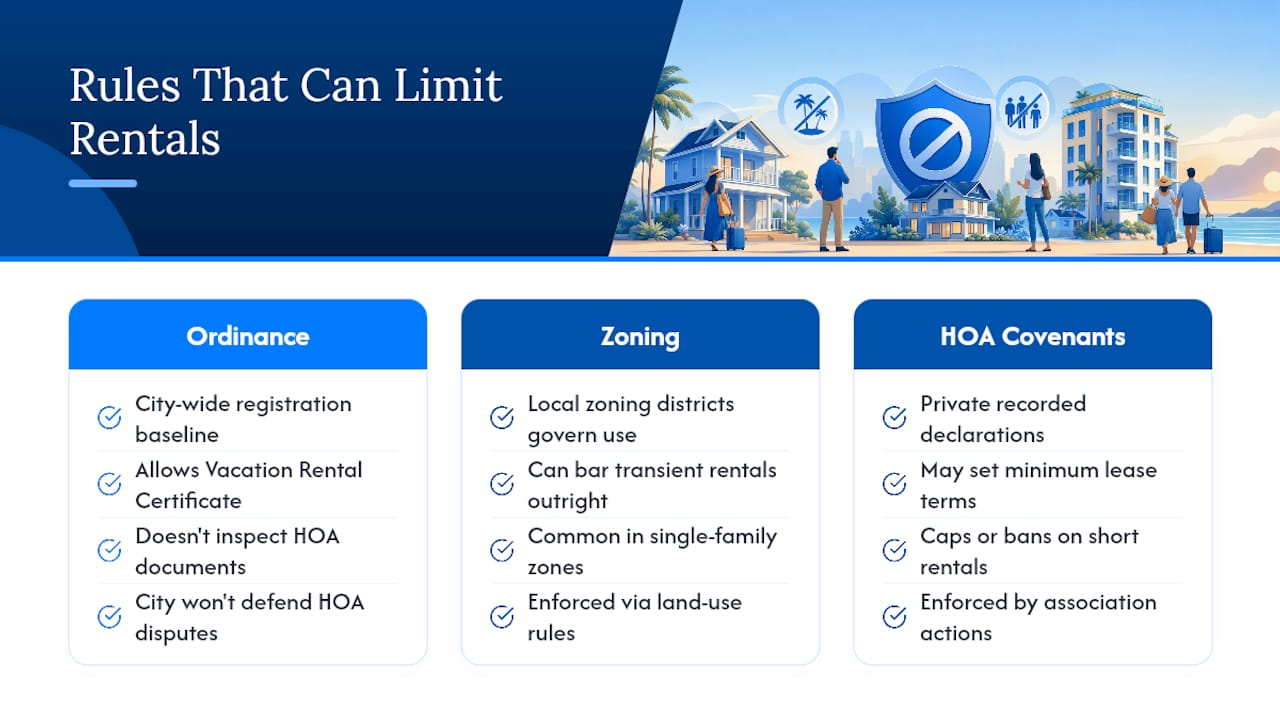
City-wide registration under Ordinance 1632 is the baseline, but it’s not the only layer you’re working with. Zoning districts and private covenants can add restrictions the ordinance itself doesn’t mention.
Some residential zoning classifications in Panama City Beach limit or restrict transient rental use outright, particularly in areas zoned for single-family residential use rather than resort or mixed-use development. A unit can be fully eligible for a Vacation Rental Certificate under the ordinance and still be barred from short-term rental use by its underlying zoning designation. That’s a conflict worth resolving before you invest in furnishing and marketing a property.
Condo associations and homeowners associations add another layer entirely, and this one trips up more first-time condo owners than any city rule. Many HOA and condo declarations include minimum lease term requirements, caps on the number of rentals permitted per year, or outright prohibitions on rentals under a certain length. The city’s certificate process doesn’t check your HOA documents for you, and the city won’t defend you if your association fines or sues you for violating a covenant the ordinance never touched.
Before closing on a property you intend to rent short-term, pull the recorded declaration of covenants and read the rental section directly, not the condensed summary a listing agent hands you. If you already own the property, request the current governing documents from your association’s management company. A property that’s perfectly legal under Ordinance 1632 can still be off-limits under its own deed restrictions.
Booking Platforms and Their PCB Compliance Obligations
Listing on a booking platform doesn’t substitute for city registration, and no platform’s terms of service exempt an owner from Ordinance 1632. The certificate requirement attaches to the property and the owner, not to whichever site the listing appears on.
That said, platforms increasingly play a role in tax collection. Some short-term rental platforms have agreements to collect and remit state sales tax and Tourist Development Tax automatically on bookings made through their site. That arrangement can simplify one part of your tax obligation, but it doesn’t replace your own TDT registration requirement, and it definitely doesn’t replace your Vacation Rental Certificate.
Owners sometimes assume that because a platform verifies their listing or displays a “compliant” badge, they’ve satisfied city requirements. Platforms don’t verify Ordinance 1632 compliance. They verify their own internal policies, which are not the same thing as a city-issued certificate number tied to your specific unit.
If you list across multiple platforms simultaneously, a common practice for maximizing bookings, your certificate and posting obligations apply to the physical unit regardless of how many booking sites reference it. One certificate, one set of postings, covering all channels through which that unit gets rented. Keep your certificate number consistent across every listing description; a mismatch between your posted signage and your online listing information is one of the easier things for code enforcement to spot during a routine check.
Insurance Coverage Every PCB Rental Owner Needs
A standard homeowner’s insurance policy typically excludes coverage for short-term rental activity, because insurers classify frequent transient occupancy as a commercial or quasi-commercial use of the property. Renting out your unit without notifying your carrier and adjusting your policy can mean a denied claim at the exact moment you need coverage most.
Owners operating vacation rentals generally need a dwelling policy specifically written for short-term rental use, along with liability coverage sized to the realistic exposure of hosting paying guests you don’t personally know. A slip-and-fall on a wet pool deck or a guest injury from a balcony railing failure carries different liability weight than the same incident involving a family member.
Flood insurance deserves separate attention given the coastal location. Standard homeowner and even short-term rental policies commonly exclude flood damage, and Gulf-facing properties sit in flood zones where a separate flood policy, often through the National Flood Insurance Program, isn’t optional in any practical sense.
If your property sits in a condo association, check whether the association’s master policy covers the interior of individual units or only the building’s common structure. Many master policies stop at the drywall, leaving interior fixtures, furnishings, and liability exposure entirely on the unit owner. Confirming this gap before your first booking, rather than after a claim, is the difference between a manageable loss and a financial disaster.
Managing Guest Behavior and Neighborhood Impact
Noise complaints and parking disputes are the most common source of neighbor friction around vacation rentals, and they’re also the fastest way to draw code enforcement attention to a property that might otherwise never get a second look.
Setting clear expectations with guests before arrival heads off most of these problems. A welcome guide that spells out quiet hours, parking boundaries, trash pickup days, and maximum occupancy gives guests no excuse for not knowing the rules, and it gives you documentation if a dispute arises.
The Rental Responsible Party’s phone number, posted on your exterior signage, exists precisely so a neighbor with a 1 a.m. noise problem has someone to call before they call the police or the city. Owners who respond quickly to that call, rather than letting a neighbor’s frustration build into a formal complaint, tend to avoid the kind of pattern that gets a property flagged for extra scrutiny during renewal.
Trash and recycling handling matters more in a beach town than owners initially assume. Overflowing bins on a windy day scatter litter across a neighbor’s yard fast, and repeated code complaints about trash can factor into how closely the city watches a given address going forward. Simple guest instructions on bin placement and pickup schedules solve most of this before it starts.
Do You Need to Notify Neighbors Before Renting?
Ordinance 1632 doesn’t require owners to individually notify neighbors before beginning short-term rental operations. There’s no formal neighbor notification process built into the city’s registration workflow, unlike some jurisdictions that require mailed notices or posted public hearing signs before a rental permit issues.
That said, the practical wisdom among experienced owners runs the other direction. A short conversation with immediate neighbors before your first guest arrives, explaining that the property will host visitors, sharing the Rental Responsible Party’s contact number, and inviting them to reach out directly with concerns, tends to prevent the kind of anonymous complaint that triggers a code enforcement visit.
Some condo associations and HOAs do impose their own notification requirements as part of their governing documents, separate from anything the city mandates. Check your association’s rules specifically, since a covenant violation for skipping an HOA-required notice is enforced entirely apart from your city certificate status.
Why the City’s Own Playbook Beats Generic Advice
Most rental compliance advice online treats short-term rental regulation as a single national issue with minor local variations. That framing actively hurts Panama City Beach owners, because Ordinance 1632 isn’t a variation on a theme. It’s a specific municipal code with its own definitions, its own certificate requirement per unit, and its own inspection standards tied to NFPA 101 and Chapter 509.
The gap that trips up new owners most often isn’t the paperwork itself. It’s assuming that a certificate from a booking platform’s onboarding flow, or a general Florida rental license, covers what the city specifically requires. It doesn’t. The DBPR license is necessary but not sufficient. The TDT registration is necessary but not sufficient. Only the full stack, city certificate included, gets you legally operational.
If I had to prioritize one thing for a first-time owner, it wouldn’t be the inspection prep. It would be reading the zoning designation and, if applicable, the HOA covenants, before doing anything else. A property that fails Ordinance 1632’s inspection can usually be fixed with a repair. A property that’s zoned against short-term rental use, or restricted by its own condo declaration, is a much harder problem to solve after you’ve already bought it.
List Your Compliant Rental With Panamacitybeachflorida
Once your Vacation Rental Certificate is issued and your postings are up, the paperwork stops being the obstacle and becomes your credibility. Panamacitybeachflorida gives compliant owners a dedicated marketplace built specifically for travelers already searching for a Panama City Beach stay, rather than competing in a generic national listing pool where your property gets lost among thousands of unrelated markets.
Every property gets its own dedicated page, direct booking support, and visibility to an audience that’s already decided on this destination and is comparing specific homes and condos, not browsing broadly. That’s a meaningfully different pool of intent than a general marketplace where Panama City Beach is one of fifty options on the map.
If your certificate, DBPR license, and TDT registration are squared away, the next step is straightforward: list your property on the Vacation Rentals marketplace and start reaching travelers who are already planning their trip here.
Sources
Recommended
About the Author
Joe Godar of the PanamaCityBeachFlorida.com Editorial Team creates destination guides, vacation-planning resources, and local travel content focused on Panama City Beach, Florida.
Our team researches local beaches, vacation rental trends, family activities, restaurants, attractions, events, and direct-booking best practices. Every guide is created to help travelers plan more confidently, experience the best of Panama City Beach, and avoid unnecessary third-party guest service fees.
PanamaCityBeachFlorida.com is part of the Emerald Coast by Owner marketing family, connecting travelers directly with verified vacation rental hosts throughout the Gulf Coast since 2016.
This article was reviewed for accuracy and updated using local destination research and current Panama City Beach vacation rental market insights.