The single best defense against vacation rental scams is refusing to pay or communicate off the official booking platform, and always using a credit card. Almost every successful scam depends on convincing you to skip that step. Before sending a dollar, cross-check the address, run the photos through a reverse-image search, and confirm the host is reachable through the platform itself. Skip any of that, and you’re gambling with your vacation fund.
TL;DR:
- Always verify the rental address across multiple platforms and run reverse-image searches on photos to identify stolen or duplicated images.
- Use a credit card paid through the platform for payment, and avoid wire transfers, gift cards, or direct off-platform payments to ensure dispute options remain available.
- Request a live video walkthrough from the host and be cautious of listings with suspiciously low prices or requests to move communication outside the platform.
- Recognize common scam signs such as requests for unverified payment methods, quick off-platform communication, and identical descriptions across different listings.
- Report any suspected scams immediately to official channels like the FTC, FBI, or the platform itself, and document all interactions before they are deleted or hosts vanish.
Table of Contents
- Common Vacation Rental Scam Types (And Why They Work)
- Rental Scam Red Flags to Catch Before You Commit
- How to Avoid Rental Scams: Your Pre-Booking Checklist
- Which Payment Methods Actually Protect You
- What to Do Immediately If You Get Scammed
- How Scammers Are Evolving in 2026
- The Real Cost of Falling for a Rental Scam
- Verifying That a Rental Platform Is Legitimate
- A Publisher’s Note on Booking Safely
- A Safer Way to Book Panama City Beach
- Where to Report a Scam or Get Official Guidance
- Sources
- FAQ
Common Vacation Rental Scam Types (And Why They Work)
Most vacation rental scams fall into a handful of patterns, and once you know them, they stop looking clever and start looking obvious.
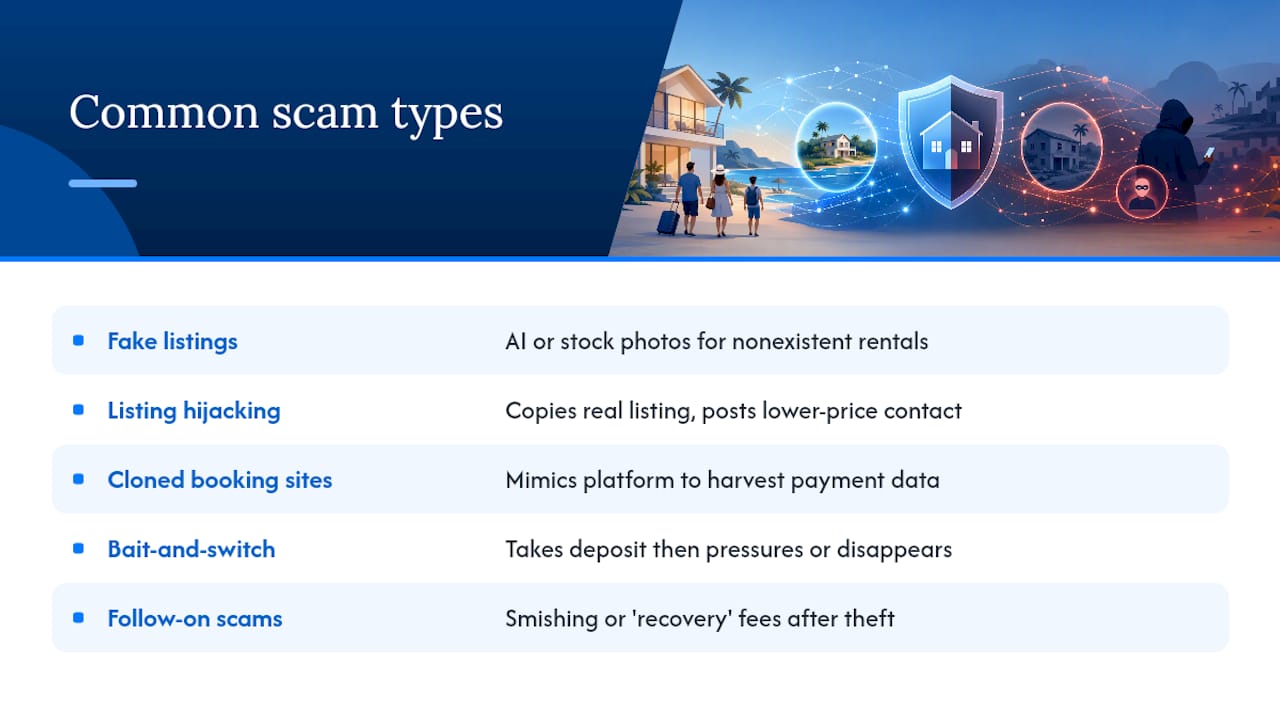
Fake listings use AI-generated or stolen stock photos to advertise a property that doesn’t exist or isn’t actually for rent. Listing hijacking is sneakier: scammers copy a real, legitimate property’s photos and description, then post it under their own contact information at a slightly lower price. Cloned booking sites mimic a trusted platform’s design almost perfectly, sending you a “confirmation” email that harvests your payment details or personal information the moment you click through.
Bait-and-switch scams take a deposit for a property, then claim a “double-booking” and either vanish or push you toward a worse (or nonexistent) replacement. And once you’ve been burned once, follow-on scams often arrive: toll-text smishing messages about a fake “unpaid fee,” or a “recovery agency” that promises to get your money back for an upfront fee. The FTC’s 2025 analysis found that about half of reported rental scams originate on Facebook Marketplace, with Craigslist a distant second. Both platforms make it trivially easy to post a listing with zero verification.
Rental Scam Red Flags to Catch Before You Commit
A handful of warning signs show up in nearly every rental fraud case. Learn to spot them, and you’ll dodge most scams before you’re even tempted to click “book.”
- The host asks you to pay by wire transfer, Zelle, gift card, or cryptocurrency instead of through the platform.
- The conversation moves quickly from the platform to email, text, or a messaging app.
- The price is noticeably lower than comparable listings nearby, paired with pressure to book “today” before someone else grabs it.
- The property has no verifiable street address, or its reviews are either nonexistent or suspiciously flawless.
- The listing photos or description show up, word for word, on a different platform under a different address.
That last one is easy to check and catches more scams than people expect.
Pro Tip: Paste a sentence or two of the listing description into a search engine in quotation marks. If it’s duplicated across three other websites with three different host names, you’ve found a hijacked listing.
How to Avoid Rental Scams: Your Pre-Booking Checklist
Run through these checks in order before you send a single payment. Each one takes a few minutes and eliminates a specific type of fraud.
- Search the address on multiple platforms. Copy the exact street address into a search engine and see if the same property appears under different names, prices, or hosts.
- Reverse-image search every photo. Google Images and TinEye can expose stolen or duplicated photos in seconds, and this single step catches a huge share of fake-listing scams.
- Ask for a live video walkthrough. A legitimate host or property manager can show you the property in real time; a scammer usually stalls, disappears, or offers a “prerecorded tour” instead.
- Pay only with a credit card, on the platform. Get a written contract with clear cancellation terms before any money changes hands.
- Walk away from any host who insists on direct payment. No property is worth losing your money over. Find another verified listing instead.
Before booking anywhere, it’s worth reading up on how to choose a vacation rental that actually fits your trip, since the same verification habits that protect you from scams also help you avoid a rental that just doesn’t suit your group.
Quick stat: Facebook Marketplace accounts for about half of all reported rental scams, according to the FTC, with Craigslist trailing behind. Listings sourced from social media marketplaces deserve extra scrutiny for exactly that reason.
Which Payment Methods Actually Protect You
Not all payment methods are created equal when it comes to fraud recovery, and the difference can mean the difference between getting your money back and losing it outright.
- Credit cards, paid on-platform, give you a real path to a chargeback if something goes wrong. Your card issuer can dispute the charge and often reverse it.
- Zelle, wire transfers, gift cards, and cryptocurrency are all but impossible to reverse once sent. The FTC specifically warns that scammers favor these methods precisely because victims can’t claw the money back.
- Platform escrow or host guarantees typically cover you only when the entire transaction, deposit included, happens inside that platform’s system.
If a host asks for a damage deposit outside the platform, insist it be processed through the platform itself or held as a refundable card hold instead. That one condition preserves your ability to dispute the charge later.
What to Do Immediately If You Get Scammed
Speed matters here. The faster you act, the better your odds of recovering any money.
- Call your credit card issuer or payment provider right away and dispute the charge. This is your strongest recovery tool if you paid by card.
- Report the listing to the booking platform and ask for transaction records or a fraud investigation.
- File a complaint at Reportfraud and, if the fraud involved wires or online payment systems, file with the FBI’s Internet Crime Complaint Center as well. Your state attorney general’s consumer protection office is worth contacting too.
- Save every screenshot, message, confirmation email, receipt, and listing URL before anything gets deleted or the host disappears.
- Ignore any “recovery service” that contacts you asking for an upfront fee. These are almost always a second scam layered on top of the first.
How Scammers Are Evolving in 2026
Generative AI has changed what a convincing scam looks like. Fake listings now come with polished photos, realistic-sounding reviews, and professional-looking confirmation documents. Polish is no longer proof of legitimacy.
Listing hijacking has gotten more sophisticated too. Scammers often use a real property’s genuine photos but swap in altered contact details or a slightly changed address, which is why cross-platform checks and county assessor lookups matter more than ever. The “fee trap” remains the most common revenue mechanism: an off-platform damage deposit or a separate “cleaning fee” that removes you from any platform protection the moment you pay it.
Pro Tip: If a booking confirmation link asks you to “verify here” on a domain you didn’t type in yourself, close it and go directly to the platform’s real website instead.
The Real Cost of Falling for a Rental Scam
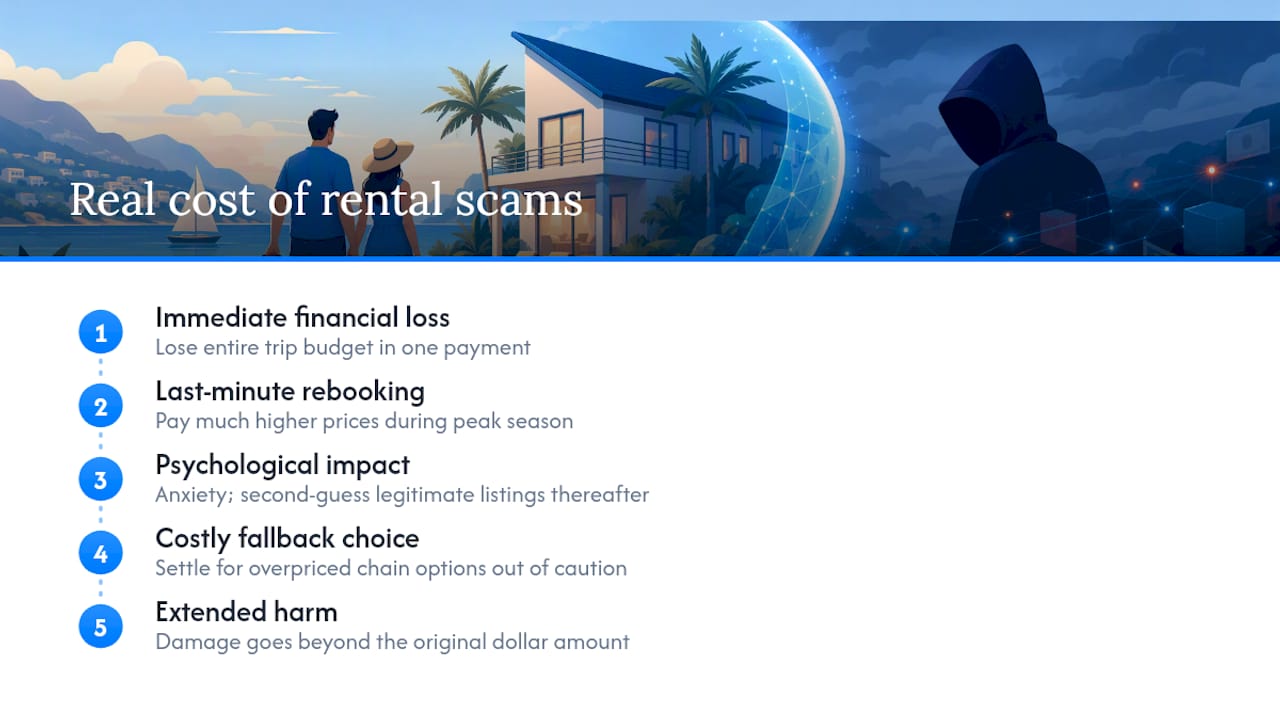
The financial hit is only part of the damage. Victims often lose their entire trip budget in a single transaction, then face the scramble of finding a last-minute replacement rental at a much higher price, sometimes during peak season when availability is already tight.
There’s a psychological toll too. People who’ve been scammed once often become anxious about booking anything at all, second-guessing legitimate listings and hosts long after the incident. That hesitation is understandable, but it can also push travelers toward overpriced, chain-brand fallback options out of pure caution, even when a perfectly good independent rental was available.
The tactics behind these scams rely on urgency and pressure specifically because they work. A too-good price paired with a countdown clock short-circuits the part of your brain that would otherwise ask basic questions. Scammers know that a shopper in a hurry skips verification steps, and they design their listings around exploiting exactly that instinct.
Families who lose a rental deposit right before a trip often face a brutal choice: eat the loss and scale back the vacation, or spend more to book emergency lodging on short notice. Either way, the scam’s damage extends well past the original dollar amount.
Verifying That a Rental Platform Is Legitimate
A platform’s legitimacy usually shows up in details that are easy to check but easy to skip when you’re excited about a trip.
Look for a platform that keeps payment and messaging inside its own system rather than routing you toward outside contact. Reputable sites publish clear cancellation policies, verified host identities, and a support channel you can reach if something goes wrong mid-stay. Reviews should show a realistic spread, not an unbroken string of five-star ratings with vague, generic wording.
It also helps to compare listings across several established booking platforms rather than relying on a single site, since consistency across platforms is one of the fastest ways to confirm a property is real. For added peace of mind on deposits and cancellations, some travelers also look into vacation rental insurance before booking a higher-cost stay.
A partner resource worth bookmarking is this guide to choosing legitimate holiday homes, which walks through similar verification habits from a slightly different angle.
A Publisher’s Note on Booking Safely
Protecting your money starts with slowing down, even for a minute, before you pay. We built our listings around clear host contact and verifiable properties for exactly that reason. Pair our vetted Panama City Beach rentals with the checks above, and you’ll book with real confidence.
— Joe
A Safer Way to Book Panama City Beach
This platform serves as an alternative to sorting through unverified marketplace listings on your own. It features properties with clear host or property-manager contact information and a direct booking path, helping reduce uncertainty about an address, a photo, or a price before you commit.
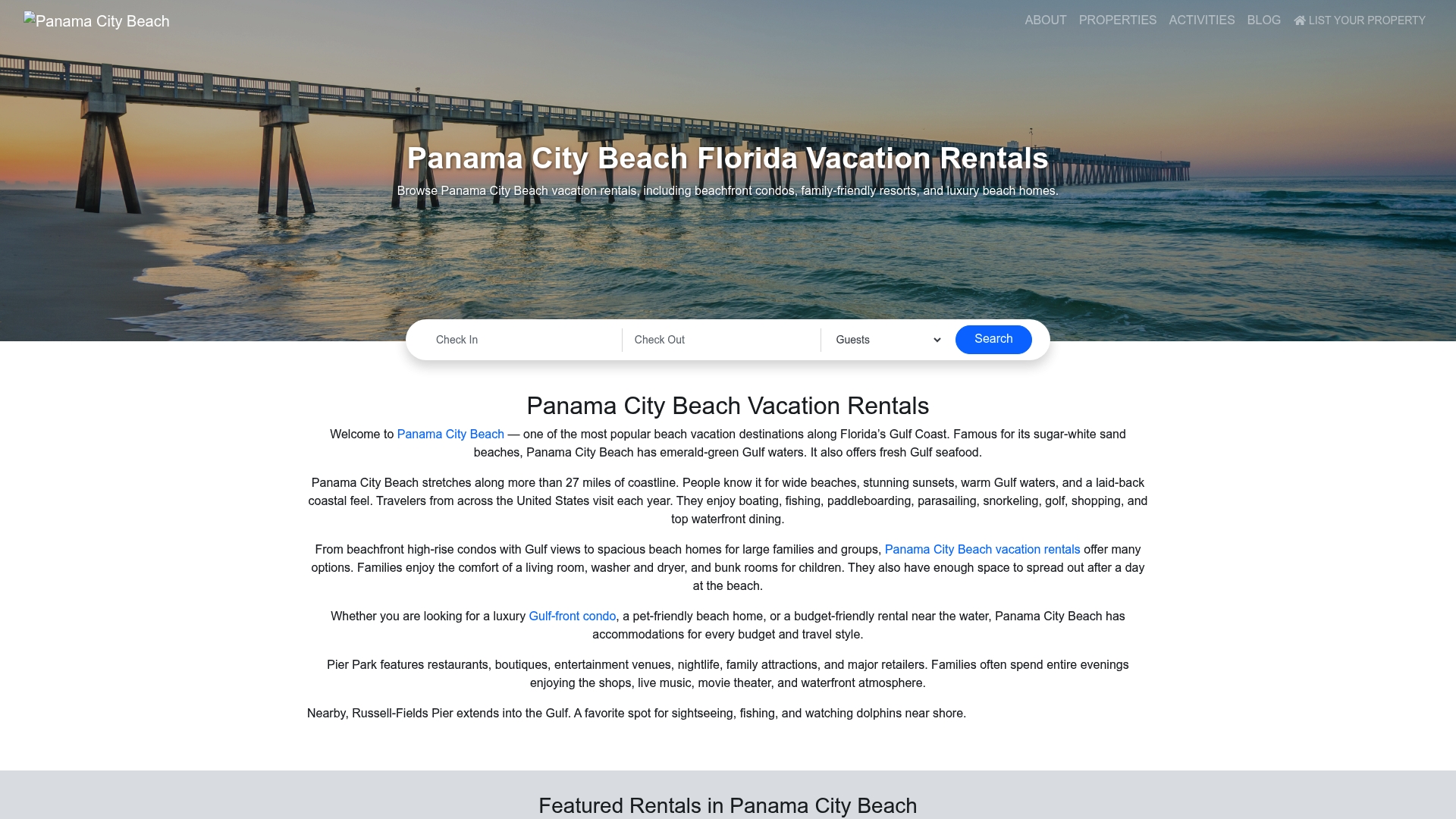
That matters most on 27 miles of coastline where beachfront demand runs high and shady listings try to ride the wave of real interest. Instead of chasing down a listing across three platforms to confirm it’s genuine, you can search our Panama City Beach vacation rentals directly, from beachfront condos to pet-friendly homes, and book with a host you can actually reach. Check availability for your dates and see what’s open for your next Gulf Coast trip.
Where to Report a Scam or Get Official Guidance
If something feels off, these are the official channels worth bookmarking now, before you need them. The FTC’s consumer advice on rental listings covers common tactics and prevention steps, and ReportFraud.ftc.gov is where you file a formal complaint. For fraud involving wires or online payment systems, the FBI’s Internet Crime Complaint Center tracks internet crime nationally. Your state attorney general’s consumer protection page can help with local enforcement.
Sources
- Rental listing scams
- Protect your customers from vacation rental scams this summer
- 2024 IC3 Annual Report
Recommended
- How to Choose a Vacation Rental That Actually Fits Your Trip
- Vacation Rental Insurance for Guests & Owners: 2026 Guide
- Vacation Rental Fees: A Guide With a Sample Calculation
- Top 5 Budget-Friendly Airbnb Alternatives 2026

About the Author
Joe Godar of the PanamaCityBeachFlorida.com Editorial Team creates destination guides, vacation-planning resources, and local travel content focused on Panama City Beach, Florida.
Our team researches local beaches, vacation rental trends, family activities, restaurants, attractions, events, and direct-booking best practices. Every guide is created to help travelers plan more confidently, experience the best of Panama City Beach, and avoid unnecessary third-party guest service fees.
PanamaCityBeachFlorida.com is part of the Emerald Coast by Owner marketing family, connecting travelers directly with verified vacation rental hosts throughout the Gulf Coast since 2016.
This article was reviewed for accuracy and updated using local destination research and current Panama City Beach vacation rental market insights.