
Yes, collect a security deposit, but keep it modest and back it with documentation, or pair a lighter deposit with a damage waiver on properties where checkout friction hurts conversion. The reason is simple: a deposit deters careless guests and speeds up your recovery on small damage, while heavy documentation protects you if a claim gets disputed. Pick your collection method (pre-authorization or captured funds) and land in a modest range depending on your property tier, then move to the specifics below.
TL;DR:
- Using a modest security deposit backed by clear documentation reduces guest carelessness while minimizing checkout friction, especially with damage waivers on lower-friction properties.
- Collection methods like pre-authorization holds or captured funds influence legal liability and guest experience, with pre-authorizations being less intrusive but needing timely capture or release.
- Deposit sizes should align with property tier, with budget listings around $200–$500 and luxury properties up to $3,000; excessively high deposits on mid-range listings can increase booking abandonment.
- Documentation with timestamped photos and supporting repair or cleaning estimates is essential to defend against disputes and demonstrate actual damages to hosts or courts.
- Hosts managing multiple channels must verify that deposit policies comply with each platform’s rules and ensure proper disclosure, especially for off-platform collection or third-party damage waivers.
Table of Contents
- What Counts as a Security Deposit Vacation Rental Policy?
- How Should You Collect a Vacation Rental Deposit?
- How Much Should a Vacation Rental Deposit Be?
- What Legal Rules Govern Vacation Rental Deposits?
- Do Airbnb and Vrbo Handle Deposits Differently?
- What Evidence Do You Need to Defend a Deduction?
- Should You Use a Deposit, a Waiver, or Both?
- How Do You Handle a Deposit Dispute?
- How Panama City Beach Hosts Put This Into Practice
- My Take on Deposits After Years of Watching Hosts Overthink Them
- List Your Property With a Marketplace Built for Direct Bookings
- Where to Verify Deposit Rules and Statutes
- Sources
- FAQ
What Counts as a Security Deposit Vacation Rental Policy?
A security deposit is refundable money you hold against damage, missing items, or excessive cleaning beyond normal wear. It differs from a cleaning fee, which you keep regardless of how the guest leaves the property, and from a non-refundable fee, which guests treat more like a price increase than a protection tool.
You’ll typically encounter three structures. A pre-authorization hold places a temporary block on the guest’s card without moving funds, ideal for low-friction bookings. A captured deposit actually transfers the money into your account at booking or check-in, then you refund it after inspection. A non-refundable fee skips the deposit model altogether and just raises your price.
What’s fair to deduct:
- Physical damage beyond normal wear (broken furniture, stained carpet, damaged appliances)
- Missing items listed in your inventory (remotes, kitchenware, linens)
- Cleaning costs that clearly exceed your standard turnover fee, such as pet hair removal you didn’t disclose pricing for or biohazard cleanup
What you should never deduct: faded upholstery, minor scuffs, or the general softening that comes from normal guest use. A deposit exists to deter bad behavior and cover real loss, not to fund every cosmetic upgrade you were planning anyway.
How Should You Collect a Vacation Rental Deposit?
Your collection method shapes both guest experience and your legal exposure, so match the method to your risk tolerance and platform rules.
- Pre-authorization hold. The card gets a temporary block, funds never actually move, and the guest sees no charge unless you file a claim. This is the least intrusive option, but expiry windows vary by processor. Stripe defaults to a seven-day hold, while some card networks support authorization windows up to 28 days, so you need to capture or release before that window closes or the hold simply disappears.
- Captured-and-refunded deposit. You charge the deposit upfront and refund it after inspection. This gives you cleaner access to funds for a claim, but it also means you’re holding guest money as a liability on your books until you either return it or retain a documented portion.
- Off-platform payment links. Some hosts request deposits outside their booking platform, usually through a payment processor’s direct link. This can work for direct bookings, but you must disclose it clearly in your listing and rental agreement, and check whether your platform’s terms even permit off-platform collection.
- Damage waiver. Instead of a refundable deposit, guests pay a small non-refundable fee that covers accidental damage up to a set limit, similar to travel insurance. Waivers convert better than deposits because there’s no checkout friction, but they typically won’t cover intentional damage or large losses.
Pro Tip: If you run a mid-range property and worry about cart abandonment at checkout, test a $75 to $150 waiver against a $300 refundable deposit for a full season. Track your booking conversion rate on both, not just your claim rate.
How Much Should a Vacation Rental Deposit Be?
Deposit size should track property tier and realistic risk, not a flat number you picked because it sounded reasonable.
- Budget properties: $200 to $500
- Standard/mid-range properties: $500 to $1,000
- Luxury properties: $1,000 to $3,000
- High-risk adjustments: add $100 to $300 for pets, hot tubs, or groups larger than eight
Houfy’s host guide recommends anchoring your deposit to 1.5 to 2 times your cleaning cost, which keeps the number proportional to your actual turnover expense rather than an arbitrary round figure. A second formula worth testing: multiply your nightly rate by a small factor, increasing with risk factors like pets or hot tubs.
Here’s the number that should change how you think about pricing: deposits above roughly $500 on mid-range listings correlate with measurably higher booking abandonment. If your standard nightly rate sits at $150 and you’re charging a $700 deposit, you may be losing bookings you never even see fail. On premium or luxury properties, guests expect a larger deposit and rarely balk, but on budget and mid-range listings, every extra $100 at checkout is friction you’re paying for in lost reservations.
What Legal Rules Govern Vacation Rental Deposits?
Security deposit rules for vacation rentals borrow heavily from landlord-tenant law, and the exact requirements shift by state. Most state statutes specify how deposits must be handled, frequently including return deadlines falling within a few weeks after checkout, and some states require you to hold deposits in a separate, segregated account rather than mixing them with operating funds.
A few guardrails apply almost everywhere:
- Stay duration matters. Extended stays, sometimes 30 days or longer depending on your state, can trigger full landlord-tenant statutes rather than the lighter rules that apply to short vacation stays.
- Return deadlines carry teeth. Wrongful withholding can carry statutory penalties in many states, and courts generally require you to send an itemized statement with receipts if you keep any portion of the deposit.
- Escrow and interest rules vary. Some states require interest on held deposits or mandate a separate trust account; check your specific statute before assuming a national standard exists.
- Bookkeeping treatment matters at tax time. Deposits are a liability, not income, until you legitimately retain a portion. Any amount you keep becomes taxable rental income in the year you retain it, so your books should reflect that shift, not lump the whole deposit in as revenue on day one.
If you own property across multiple states, this is the section worth revisiting every year, since statutes get amended more often than most hosts expect. A partner resource on Florida rental regulations is a useful starting point if you’re weighing how state-specific rules affect your holding strategy.
Do Airbnb and Vrbo Handle Deposits Differently?
Booking channels don’t treat deposits the same way, and mixing up their rules is one of the more common host mistakes.
Airbnb removed traditional host-set deposits in most markets and now uses AirCover, a built-in protection program. Hosts may collect deposits off-platform if allowed and disclosed. Vrbo generally lets hosts set refundable damage deposits on-platform, providing greater control over claims.
For multi-channel managers, a working checklist looks like this:
- Confirm your property management software supports per-channel deposit rules, not a single blanket setting
- Verify your payment processor accepts the hold type each channel requires (pre-auth versus captured)
- Disclose your deposit policy in the listing description, not buried in a rental agreement guests skip
- Set automated reminders for refund deadlines so nothing slips past your state’s statutory window
A PMS-focused guide on automating deposit workflows covers how to tie check-in codes to completed payment, which solves the collection problem for hosts juggling several channels at once.
What Evidence Do You Need to Defend a Deduction?
Documentation is what separates a defensible deduction from a guest dispute you lose. Deposit deductions are defensible only when supported by timestamped before-and-after photos, repair or cleaning estimates, and prompt guest notification.
- Photograph and video everything before check-in. Walk the property within two hours of arrival and capture every room, focusing on furniture, appliances, and anything guests might later claim was “already like that.”
- Repeat the walkthrough immediately after checkout. Same rooms, same angles, same lighting where possible, so the comparison is airtight.
- Gather supporting paperwork fast. Repair estimates, cleaner invoices, and replacement receipts all strengthen your claim; a photo alone rarely settles a dispute.
- Notify the guest within 24 hours. Contacting the guest quickly with photos and an itemized estimate preserves your credibility far better than a claim filed a week later after the trail has gone cold.
Pro Tip: Store every photo directly in your property management software, linked to the specific booking ID. If a dispute reaches a platform’s resolution team or small claims court months later, you don’t want to be digging through your phone’s camera roll for evidence.
Should You Use a Deposit, a Waiver, or Both?
Layering protection usually beats picking one tool and hoping it covers everything.
A damage waiver improves conversion because guests pay a small, non-refundable fee upfront instead of facing a large hold at checkout, but waivers typically cap coverage and exclude intentional damage. Short-term rental insurance covers larger incidents, liability claims, and sometimes lost income, but it rarely reimburses the small, everyday damage a deposit is built to catch, like a stained rug or a broken lamp.
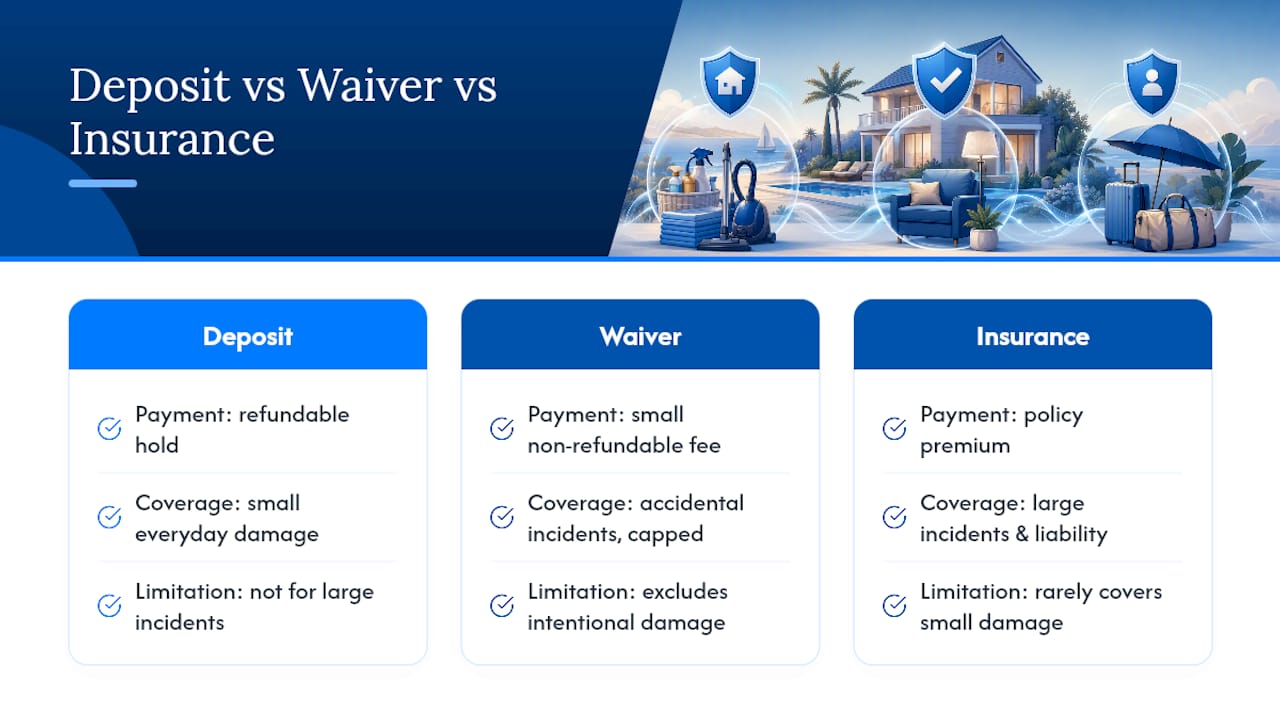
The strongest setup for most mid-range and luxury properties combines all three: a modest refundable deposit for quick, low-friction recovery on small damage, a waiver to cover accidental incidents guests are willing to pay a small fee to avoid disputing, and insurance as the backstop for anything that exceeds both. No single tool covers the full range of what can go wrong in a short-term rental.
How Do You Handle a Deposit Dispute?
Speed and paperwork win disputes; vague memory and delay lose them.
- Document immediately. Photograph the damage, get a repair or replacement estimate, and notify the guest within 24 hours with an itemized breakdown.
- Proportion your deduction fairly. Deduct only the actual cost or a reasonable estimate, not a round number that feels justified. Attach receipts to every line item.
- Set a clear refund timeline. Return the undisputed portion promptly, ideally within seven days, and hold only the contested amount pending resolution.
- Escalate only when necessary.** If the guest disputes your claim, most platforms offer a resolution center for claims under a certain threshold. For larger disputes or repeat non-payment, small claims court remains an option, though it’s rarely worth the time for amounts under a few hundred dollars.
How Panama City Beach Hosts Put This Into Practice
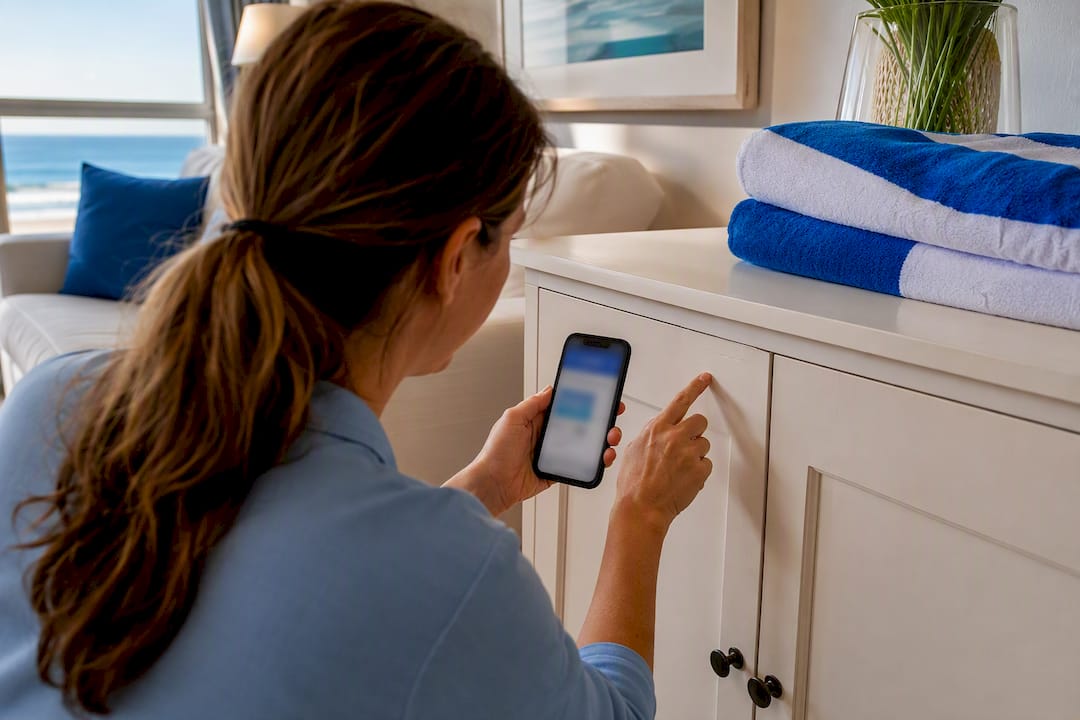
Picture a direct-booking beach condo that locks check-in codes until the deposit clears, paired with a two-hour pre-arrival photo walkthrough logged against the booking ID. That single workflow change, using self-check-in systems tied to payment confirmation, tends to cut disputes and speed up refund turnaround because the evidence trail already exists before a guest ever unpacks. Hosts running this setup report fewer arguments over “it was already broken” claims. Proprietary case data and Joe’s full credentials will be added as future field results come in.
My Take on Deposits After Years of Watching Hosts Overthink Them
Most hosts either charge too much out of fear or skip deposits entirely out of laziness, and both mistakes cost money. The fix isn’t complicated: take pre-arrival photos every single stay, and promise guests a 48-hour refund if the inspection comes back clean. Run a modest deposit against a waiver for one season and measure which one actually moves your booking conversion. The data will tell you more than any gut instinct ever will.
— Joe
List Your Property With a Marketplace Built for Direct Bookings
Our marketplace gives you a direct path to guests without routing every deposit decision through a third-party platform’s rulebook. Listing here means you control your own deposit policy, disclosure language, and refund timeline, rather than adapting your workflow to external booking channel rules.

Whether you’re weighing a modest refundable deposit or a damage-waiver stack, our marketplace for Panama City Beach vacation rentals gives you the listing tools to set your terms clearly and connect directly with guests who see your policy before they book. If you manage multiple units or want to align your deposit approach across properties, reach out through the main site to talk through your listing options and get your deposit workflow set up correctly from the start.
Where to Verify Deposit Rules and Statutes
Deposit rules shift by state and by platform, so check primary sources before finalizing your policy. Nolo’s state-by-state statute list covers return deadlines and escrow requirements, while LegalClarity’s breakdown of deposit laws explains penalties for wrongful withholding. Always confirm your specific state statute before finalizing a policy, since requirements change more often than most hosts expect.
Sources
- Nolo — State security deposit statutes
- Houfy — Vacation rental damage deposits: complete host guide
- AirROI — Security deposit (glossary)
- PayRequest — Short-term rentals security deposit: host guide
- LegalClarity — Vacation rental security deposit laws, limits & disputes
Recommended
- Vacation Rental Fees: A Guide With a Sample Calculation
- Vacation Rental Insurance for Guests & Owners: 2026 Guide

About the Author
Joe Godar of the PanamaCityBeachFlorida.com Editorial Team creates destination guides, vacation-planning resources, and local travel content focused on Panama City Beach, Florida.
Our team researches local beaches, vacation rental trends, family activities, restaurants, attractions, events, and direct-booking best practices. Every guide is created to help travelers plan more confidently, experience the best of Panama City Beach, and avoid unnecessary third-party guest service fees.
PanamaCityBeachFlorida.com is part of the Emerald Coast by Owner marketing family, connecting travelers directly with verified vacation rental hosts throughout the Gulf Coast since 2016.
This article was reviewed for accuracy and updated using local destination research and current Panama City Beach vacation rental market insights.