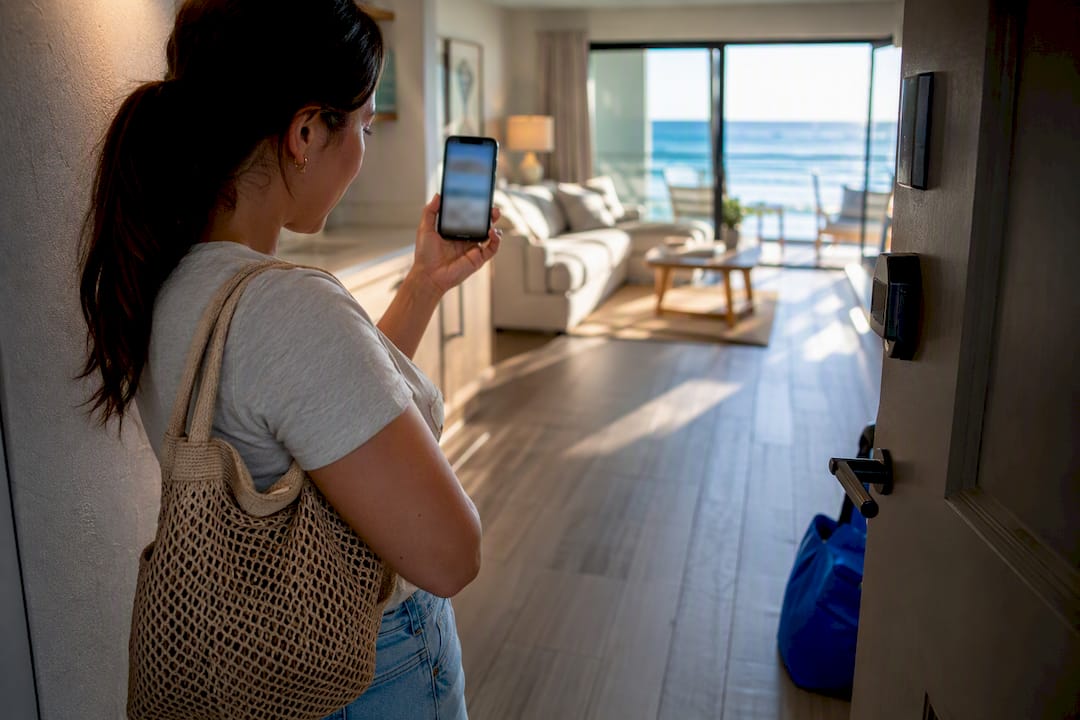
Do not pay off-platform, and do not move your conversation to text or personal email before you book. Run a 15-minute verification routine first: check the photos, confirm the address, read the negative reviews, and keep every dollar inside the platform’s payment system. If a listing clears those checks, book it with a credit card and enjoy the trip.
TL;DR:
- Verify the listing by reverse-image searching photos and checking the address on Google Maps and Street View to detect potential fakes.
- Read multiple reviews over months or years, especially negative ones, to identify suspicious patterns and inconsistent host histories.
- Always pay through the platform’s official system with a credit card, avoiding wire transfers, cash apps, or direct email requests to prevent irreversible scams.
- Confirm the host’s identity using platform badges, long-standing review histories, and specific questions about the property to avoid fake hosts.
- Spot overly low prices or excessive availability during peak times as red flags that the listing may be a scam or misrepresented.
Table of Contents
- What Does It Mean to Verify a Vacation Rental?
- How Do You Verify Listing Photos and Descriptions?
- How Do You Confirm the Host Is Legitimate?
- What Payment Methods Actually Protect You?
- What Should You Do If a Listing Seems Like a Scam?
- Where Can You Find More Panama City Beach Verification Help?
- How Do You Verify a Host’s Identity?
- Should You Check Local Property Ownership Records?
- Why Does Confirming Cancellation and Refund Terms Matter?
- Is a Suspiciously Low Price a Warning Sign?
- Habits Worth Building for Every Booking
- Book With Confidence Through PanamaCityBeachFlorida.com
- Sources
- FAQ
What Does It Mean to Verify a Vacation Rental?
Verifying a vacation rental means confirming that a listing is real, that the photos and description match the actual property, and that the host is who they claim to be before you send any money. It is different from checking a property’s short-term rental license or local permit status. That’s a legal compliance question for owners and cities, not something you need to research as a guest. What you need is a fast, practical way to confirm the vacation rental listing you’re eyeing on Panama City Beach, or anywhere else, is legitimate and worth your money.
Here’s the routine, broken into five steps you can finish before your coffee gets cold.
- Save two or three listing photos and reverse-image search them. Right-click and search in Google Images, or drop them into Google Lens. If the same photos show up on a real estate site, a different rental platform under another name, or a listing in a different city, walk away.
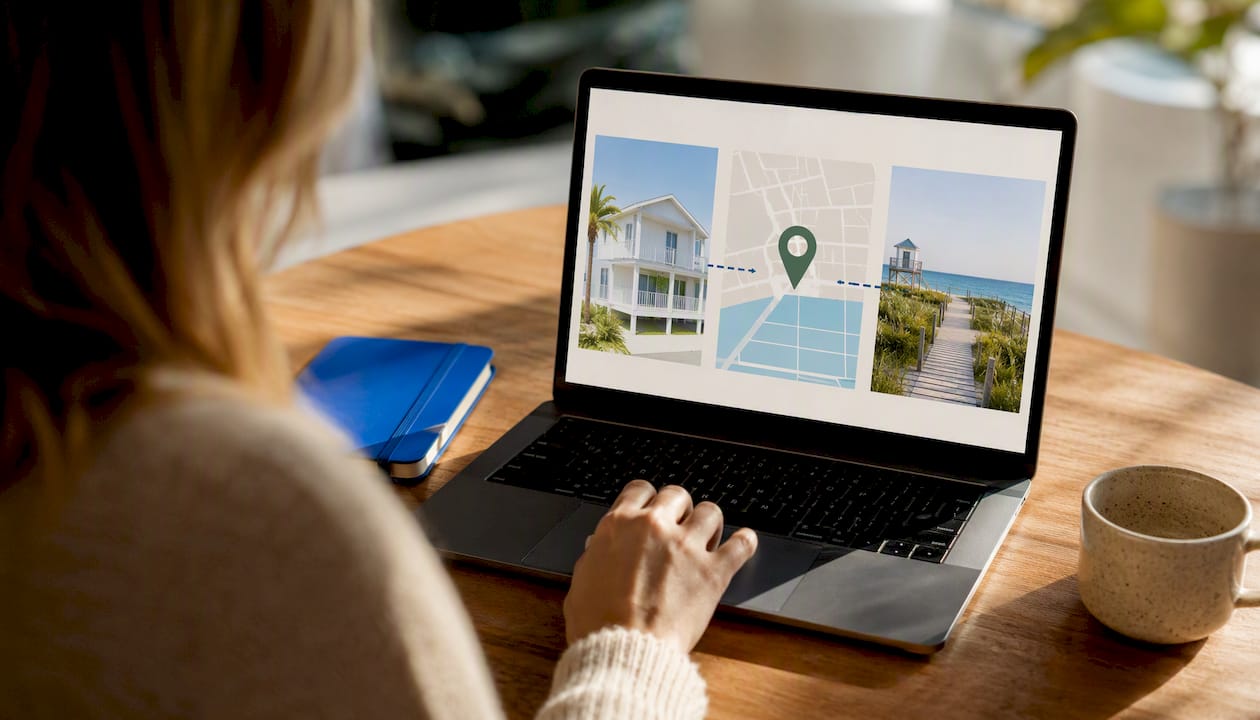
- Verify the address on Google Maps and Street View. Match the building’s exterior, the parking situation, and the surrounding block to what the listing shows. A property that “doesn’t exist” at the given address is the single clearest scam signal there is.
- Check the review history, starting with the worst reviews. Look for months or years of activity, not five perfect reviews posted last week.
- Confirm every message and payment request happens inside the platform. Any request to text, call, or email outside that system is a reason to stop.
- Search for the same property on other sites. A legitimate host often lists across multiple booking platforms, and the price and details should roughly match everywhere you find it.
Pro Tip: Do steps 1 and 2 first, in that order. Reverse-image search and a Street View check catch the majority of fake listings on their own, and together they take under five minutes.
How Do You Verify Listing Photos and Descriptions?
Reverse-image search is the fastest way to unmask a stolen listing. Save a photo, open Google Images or Google Lens, and search it. If the exact same image appears attached to a different address, a different host name, or a real estate listing for a home that sold two years ago, you’ve found your answer. Scammers routinely lift photos from legitimate rentals and real estate pages because original photography is expensive and stolen images are free.
Beyond the reverse search, look for these details:
- Very few photos, or only wide shots that hide the actual layout and condition
- Inconsistent photo styles, as if images were pulled from several different sources
- No exterior shots, no shots of the building entrance, and no nearby landmarks visible
- Stock-looking staging that feels generic rather than lived-in
Copy a distinctive sentence from the property description and paste it into Google in quotation marks. Duplicate listings with the exact same copy on different sites, under different names, is a red flag worth taking seriously.
Pro Tip: If anything still feels off, ask the host for a short live video walkthrough. A real host can do this in five minutes; a scammer running a fake listing usually stalls, ignores the request, or disappears.
How Do You Confirm the Host Is Legitimate?
A host’s review history tells you more than their profile bio ever will. Look for reviews spanning several months or years across different guests, not a burst of five-star reviews all posted in the same week. New listings with a suspiciously perfect review record deserve extra scrutiny, since a coherent pattern of long-term, varied feedback is much harder to fake than a handful of glowing posts.
Start with the lowest-rated reviews, not the highest. Guests who had a bad experience tend to describe exactly what went wrong: a mismatched address, a host who vanished after payment, or amenities that didn’t exist. That’s the pattern you’re screening for.
A few more checks worth the extra two minutes:
- Search the host’s name, phone number, and email address on Google to see if complaints, other listings, or scam warnings surface.
- Ask a specific question in your platform messages, something only someone who has actually seen the property could answer (parking location, walk time to the beach, whether the pool is shared or private).
- Expect a timely, detailed reply. Vague, delayed, or copy-paste answers are a warning sign.
- Notice if the host pushes urgency, phrases like “another guest is looking at this right now.” That pressure tactic is designed to shortcut your verification, not help you book faster.
What Payment Methods Actually Protect You?
Pay through the platform’s official checkout, with a credit card, every time. Platform payment flows come with documented dispute processes and host guarantees, and credit cards add chargeback rights on top of that. That combination is one of the strongest consumer remedies available if a booking turns out to be fraudulent, and staying on-platform is what keeps those remedies intact.
Certain payment requests should stop you cold:
- Wire transfers
- Zelle or other peer-to-peer cash apps
- Cryptocurrency
- Gift cards
- Any request to “just email me directly” to finish the booking
A quick industry note: Payment method is frequently what determines whether a victim gets their money back. Guests who stayed on-platform and paid by credit card had far better odds of reimbursement than those who wired money or used Zelle, according to risk-management guidance from the Federal Reserve Bank Services network. Off-platform payment methods are typically irreversible the moment they clear.
If a host pressures you to pay outside the platform, treat that pressure itself as the scam signal, not just a formality to work around. Pause, don’t send anything, and consider reporting the listing. Keep every receipt, confirmation email, and message thread. If you ever need to dispute a charge, that paper trail is what makes the case.
What Should You Do If a Listing Seems Like a Scam?
If you’ve already paid, stop any additional payments and contact your card issuer immediately to flag the charge and start a dispute.
- Screenshot everything: the listing, your messages, payment confirmations, and the exact URL before it can be taken down.
- Report the listing to the platform’s trust and safety team so it gets pulled before another traveler falls for it.
- File a complaint with the FTC and, if money changed hands under false pretenses, consider a local police report.
- Rebook through a verified listing, and check whether guest insurance or a refund policy can help you recover any losses.
Gathering that evidence fast matters more than it might seem. Platforms and card issuers move faster on disputes filed with complete documentation than on vague after-the-fact reports.
Where Can You Find More Panama City Beach Verification Help?
Panama City Beach draws vacationers chasing miles of sugar-white sand, and that popularity is exactly why scammers target it. Our destination guides exist to help you book with confidence instead of guesswork. If you want a deeper breakdown of which platforms offer the strongest built-in protections, our guide to the best vacation rental sites for beach trips walks through it. And if you want the fuller picture on where scams actually originate, our post on vacation rental scams covers the platforms where fraud shows up most often and why paying on-platform matters so much.
For Panama City Beach specifically, local checks add another layer of confidence. Match the listing photos against Street View for the actual block. Confirm the beach access point, the nearby landmarks, and whether the property is truly beachfront or a few blocks back, details that are easy to fudge in a description but hard to fake once you check the map.
How Do You Verify a Host’s Identity?
Most major rental platforms offer some form of identity verification, often shown as a badge on the host’s profile confirming they’ve submitted a government ID, a verified phone number, or a confirmed payment method. Treat that badge as a helpful signal, not a guarantee. It tells you the platform has checked the host’s identity against their own systems; it doesn’t tell you the property description is accurate or that the host will be responsive.
Cross-reference what the badge confirms with what you can check yourself. If the host’s profile lists a name, search that name alongside “Panama City Beach rental” or the property address to see what surfaces. A host with a long-standing profile, consistent contact information, and a track record of responding to guest questions is a far safer bet than a brand-new account with a single listing and no history.
If a platform offers a “verified host” or “superhost”-style distinction based on completed stays and guest ratings, weigh it alongside the review timeline you already checked. A badge earned over dozens of completed bookings carries more weight than a badge based purely on submitting an ID. When in doubt, ask directly in your platform messages: “Can you confirm you manage this property yourself, or is a management company involved?” A legitimate host answers plainly. A scammer running multiple fake listings tends to dodge the question or give an answer that doesn’t match the profile details.
Should You Check Local Property Ownership Records?
For some destinations, county or city property appraiser websites let you search an address and see who owns the parcel. If Panama City Beach’s Bay County property records show an owner name that has nothing in common with the host’s profile name, that’s worth asking about directly, though it isn’t automatically damning. Plenty of legitimate rentals are owned by an LLC, a family trust, or managed by a property manager acting on the owner’s behalf, so a name mismatch alone doesn’t confirm fraud.
Treat a public ownership search as one more data point, not a verdict. It works best combined with everything else: the address matching Street View, the review history checking out, and the host answering specific questions about the property without hesitation. If a host refuses to explain a basic ownership mismatch, or gets defensive when you ask, that reaction tells you more than the record itself.
Not every county makes property records easy to search online, and this step takes more time than the core 15-minute routine. Use it as a tiebreaker when something about a listing still nags at you after the faster checks, not as a mandatory step for every booking.
Why Does Confirming Cancellation and Refund Terms Matter?
Read the cancellation policy before you book, not after plans change. Rental platforms typically offer a range of policies, from flexible (full refund if you cancel a set number of days out) to strict (partial or no refund once booked). A legitimate listing states this clearly on the booking page, in plain language, before you enter any payment information.
If a host tries to negotiate cancellation terms over direct message, outside of what the platform displays, treat that as a mismatch worth questioning. Refund terms that live only in a chat message and not in the platform’s official booking record are much harder to enforce if a dispute comes up later. The policy shown at checkout is the one that should govern your stay.
It’s also worth checking what happens if the host cancels on you, not just the reverse. Most platforms guarantee some form of rebooking assistance or refund if a host cancels last minute, which matters more than it seems during peak season, when comparable beachfront condos and Gulf-front homes can book up fast. If a trip falls through entirely, guest insurance options can also soften the financial hit.
Is a Suspiciously Low Price a Warning Sign?
Yes, and it’s one of the most reliable ones. The FTC specifically flags listings priced far below comparable properties in the same area as a major red flag scammers use to lure in guests fast, before anyone has time to verify the details. If every beachfront condo on your search results is running $200 to $300 a night and one listing with better photos is $90, that gap is the bait, not a bargain.
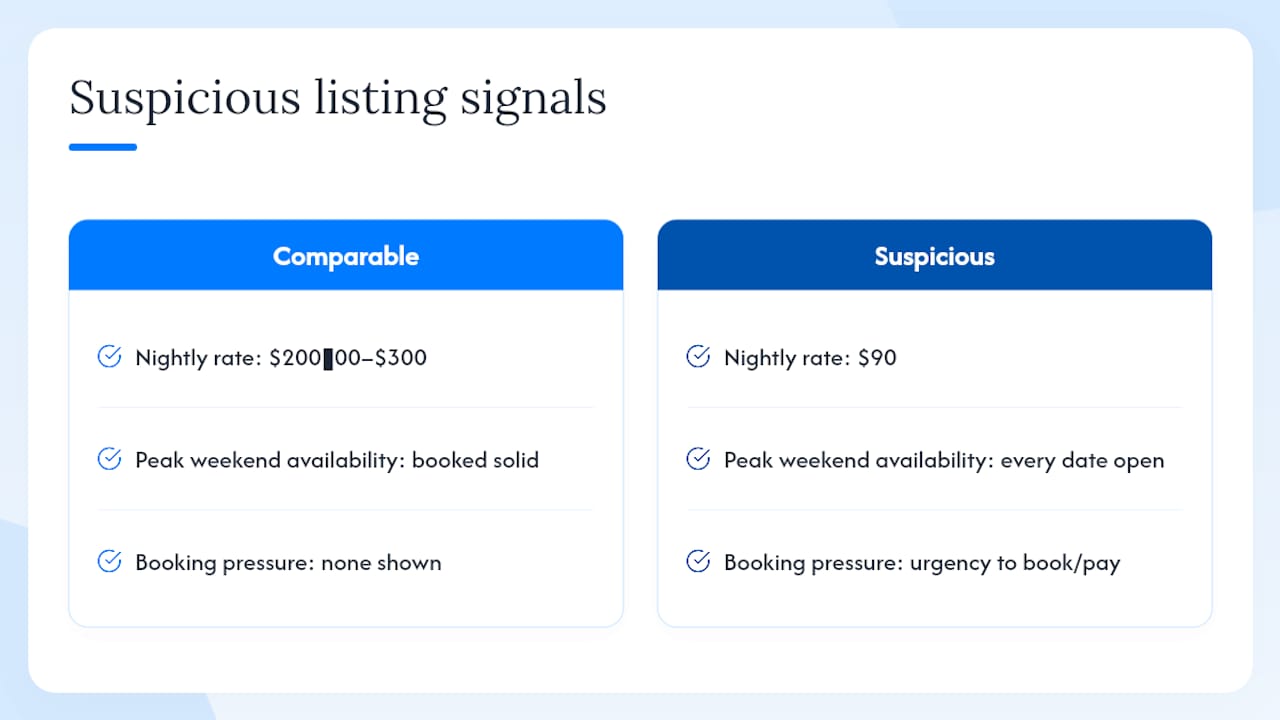
The same logic applies to suspiciously wide-open availability. A beachfront property in Panama City Beach that shows every date open during peak summer weekends, when comparable units are booked solid, should raise a question. Either the listing is fake, or something else about it (poor location, ongoing construction, unresolved issues) is keeping it empty, and the description simply isn’t telling you why.
Pair a too-good price with any urgency pressure and you’ve got the classic scam combination: a deal that feels too good to pass up, paired with a push to book and pay immediately before you can think it through. That combination alone should be enough to slow down and run the full checklist before typing in a card number.
Habits Worth Building for Every Booking
I run the same short routine before every rental I book, and it’s saved me from at least one listing that had all the right words and none of the right details. Reverse-image search the photos, check the address on Street View, and read the worst reviews before the best ones. It takes less time than picking a restaurant for dinner that night.
The habit that matters most isn’t any single step. It’s doing all of them, every time, even when a listing looks polished and the price seems fair. Scammers get better at mimicking legitimate listings every year, and the checklist is what catches what a quick glance misses. Make it routine, not a one-time exercise you skip once you feel experienced.
— Joe
Book With Confidence Through PanamaCityBeachFlorida.com
Once a listing passes your verification checklist, the next question is where to actually book it. The site provides access to listings for beachfront condos, family-friendly homes, and pet-friendly beach houses along the coast.
Every listing on the site is tied to a real property and a real owner, and we encourage the same habits this article walks through: book through the platform, pay by credit card, and use our guides on choosing the right rental to double-check fit before you commit. If you’re planning a beach trip that involves a group or extra gear, partner resources on beach-ready rental vans can help round out the logistics too.
Ready to see what’s available? Browse Panama City Beach vacation rentals now and check dates for your trip.
Sources
For deeper guidance, read the FTC’s rental listing scams advisory, the Federal Reserve Bank Services fraud-prevention brief, and the Making Sense of Security playbook on spotting fake listings. Our own vacation rental scams post covers Panama City Beach specifics in more depth.
- FedFach — risk-management property rental scams (FRB Services)
- Rental listing scams | Federal Trade Commission
- Vacation rental scams are surging: Here’s how summer travelers can protect themselves | ConsumerAffairs
Recommended
- 3 Listing Details for Panama City Beach Self Check In Rentals
- How to Choose a Vacation Rental That Actually Fits Your Trip
- Panama City Beach Rentals by Owner: 2026 Guide

About the Author
Joe Godar of the PanamaCityBeachFlorida.com Editorial Team creates destination guides, vacation-planning resources, and local travel content focused on Panama City Beach, Florida.
Our team researches local beaches, vacation rental trends, family activities, restaurants, attractions, events, and direct-booking best practices. Every guide is created to help travelers plan more confidently, experience the best of Panama City Beach, and avoid unnecessary third-party guest service fees.
PanamaCityBeachFlorida.com is part of the Emerald Coast by Owner marketing family, connecting travelers directly with verified vacation rental hosts throughout the Gulf Coast since 2016.
This article was reviewed for accuracy and updated using local destination research and current Panama City Beach vacation rental market insights.